
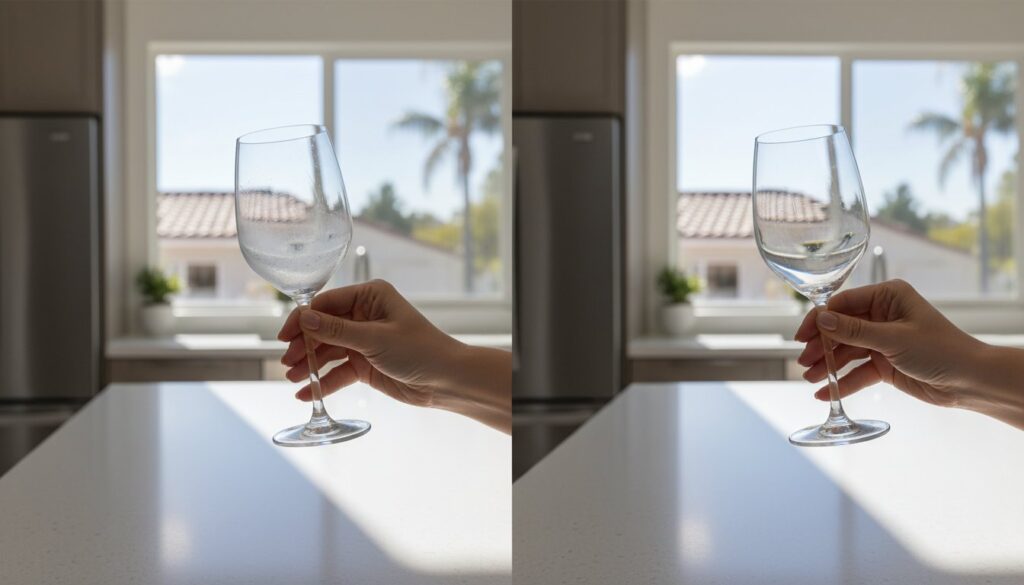
Did you know that water in Anaheim reaches a hardness level of 18 grains per gallon? This “very hard” water means your dishwasher isn’t just fighting food; it’s battling a mineral invasion that leaves glassware looking like it was pulled from a dusty construction site. You shouldn’t have to spend your weekends hand-scrubbing cloudy streaks to avoid embarrassment when hosting guests. It’s frustrating to invest in a quality appliance only to wonder why is my dishwasher leaving white residue on your favorite dinnerware.
You deserve spotless, crystal-clear dishes every time you hit the start button. This guide helps you restore a professional shine and prevent permanent etching on your expensive crystal. We’ll help you determine if your Irvine home’s 16 GPG water hardness requires a water softener system or if a specific mechanical component is failing. You will learn how to calibrate your cleaning routine and when to call for an expert diagnostic to prevent long-term scale damage to your appliance.
Key Takeaways
- Identify the direct link between Orange County’s hard water levels and the calcium carbonate film clouding your glassware.
- Understand why is my dishwasher leaving white residue and how to calibrate your detergent and rinse aid for a spot-free finish.
- Recognize signs of mechanical failure, such as a faulty heating element, that prevent detergent from dissolving properly.
- Learn how to protect high-end appliances from permanent scale damage with professional preventative maintenance.
- Determine when to schedule a same-day diagnostic to fix restricted water flow and restore your appliance’s performance.
What Is the White Residue on Your Dishes?
White residue isn’t just a cosmetic annoyance; it’s a chemical byproduct of your local environment. Most often, that cloudy film consists of calcium carbonate or undissolved detergent solids. In 2026, many homeowners find themselves asking why is my dishwasher leaving white residue despite using high-end cleaning pods. The answer often lies in the evolution of detergent chemistry. Wikipedia explains the role of phosphates in historical formulas, which were once essential for neutralizing hard water minerals. Without these agents, modern detergents struggle to keep minerals from bonding to your glassware.
The problem is compounded by modern appliance design. Current eco-cycles are engineered to use less water and lower temperatures to meet strict energy standards. While this is better for the planet, it is often insufficient for dissolving solids in mineral-heavy environments. When water doesn’t reach the necessary temperature or volume, detergent doesn’t fully activate. This leaves a gritty, white slurry behind on your plates and inside the tub. Understanding why is my dishwasher leaving white residue starts with a simple home test to identify the culprit.
The Vinegar Test: Film vs. Etching
Before you call for a repair, you must determine if your dishes are dirty or permanently damaged. Follow these steps to diagnose the issue:
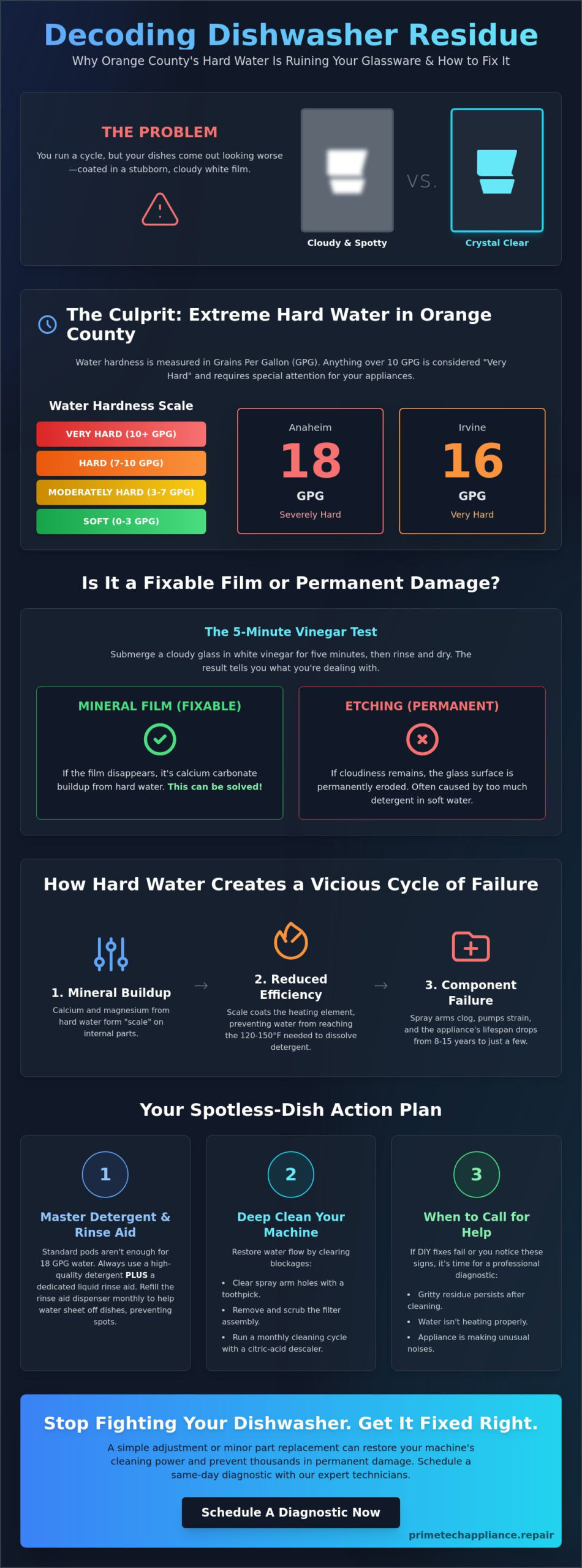
- Submerge a cloudy glass in a bowl of pure white vinegar for five minutes.
- Rinse the glass with fresh water and dry it with a clean cloth.
- Inspect the surface under a bright light.
If the film disappears, you have a mineral buildup problem that we can solve through calibration or cleaning. If the cloudiness remains, your glassware has “etching.” This is permanent surface erosion. It typically happens when you use too much detergent in soft water or when the wash temperature is excessively high. Knowing the difference saves you from replacing glasses that only need a better rinse cycle.
Why Orange County Water Affects Your Appliance
Orange County residents face unique challenges due to exceptionally high mineral counts. The City of Anaheim reports water hardness levels reaching 18 grains per gallon (GPG). In Irvine, the average sits around 16 GPG. For context, any measurement over 10 GPG is classified as “very hard” by industry experts. These minerals don’t just coat your dishes; they settle into your dishwasher’s internal plumbing. Scale builds up on the heating element, reducing its ability to reach the 120-150 degree temperatures required for a proper clean. Standard factory settings are rarely optimized for the extreme conditions found in Santa Ana or Newport Beach homes. Without professional adjustment, your appliance’s lifespan could drop significantly below the standard 8 to 15 year average.
Common DIY Fixes for Dishwasher Film
If your vinegar test confirmed a mineral film, you can likely resolve the issue with a few strategic adjustments. Many homeowners mistakenly believe that adding more soap will solve the problem. In reality, excessive detergent in a high-efficiency machine can actually worsen the cloudiness by creating a thick slurry that doesn’t rinse away. In 2026, modern dishwashers often use less than three gallons of water per cycle. This limited volume makes it difficult to flush away over-measured powders or heavy gels, especially when fighting local mineral levels.
Mastering Detergent and Rinse Aid
Don’t assume your multi-action pod handles everything. These products often fail to overcome the 18 GPG hardness found in Anaheim homes without extra help. Consumer Reports tests highlight that while some detergents lead the pack, they still require a dedicated rinse aid to achieve a spot-free finish. Rinse aid is a surfactant; it breaks the surface tension of the water so it sheets off your dishes instead of forming droplets. Refill your dispenser every 30 days to ensure consistent performance. If your appliance features an internal water softener, check your manual to calibrate it specifically for the 16 GPG hardness typical in Irvine.
Deep Cleaning Your Machine
Mechanical blockages often answer the question of why is my dishwasher leaving white residue on your plates. If the spray arms are clogged with mineral scale or food debris, water cannot reach every corner of the tub. This leaves detergent stuck on the upper rack. Follow these steps to restore flow:
- Remove the upper and lower spray arms and clear the nozzle holes with a toothpick.
- Rotate the filter assembly counter-clockwise to remove it, then scrub it with a soft brush and warm, soapy water.
- Inspect the sump area for trapped seeds, glass shards, or grease that might restrict drainage.
- Run a “clean cycle” once a month using a citric acid-based descaler to strip existing calcium from the internal plumbing.
Regular maintenance prevents the chalky buildup from becoming a permanent fixture in your kitchen. However, if these steps don’t stop you from asking why is my dishwasher leaving white residue, you might have a failing internal component. Our team provides expert dishwasher repair to diagnose complex heating or valve issues that DIY cleaning can’t fix. Addressing these technical failures early prevents long-term damage to your appliance’s motor and seals.
When the Problem Is Mechanical: Professional Troubleshooting
Sometimes, a deep clean isn’t enough to solve the problem. If you’ve scrubbed your filter and changed your detergent but still wonder why is my dishwasher leaving white residue, the culprit is likely a failing mechanical part. Precision appliances require every component to work in perfect harmony. When one part fails, the entire cleaning cycle collapses, leaving your dishes covered in a chalky mess. Our technicians frequently find that mechanical issues in Orange County homes are accelerated by the high mineral content in the local water supply.
The Heating Element and Water Temperature
Most modern detergents require water temperatures between 120°F and 150°F to dissolve properly. You can check your water temperature by running the kitchen faucet for a minute and measuring the stream with a candy thermometer. If the water inside the tub remains lukewarm during a cycle, your heating element or thermostat has likely failed. While there are valid environmental reasons for removing phosphates from detergents, this change means your dishwasher’s heating element must work harder to ensure a clean finish. Low temperatures prevent the necessary chemical activation in modern, eco-friendly detergents. Look for visible cracks or “blisters” on the heating loop at the bottom of the tub; these are clear signs of a burnt-out component that needs an immediate swap with OEM parts.
Inlet Valves and Drainage Issues
A worn water inlet valve is a frequent offender in cities like Anaheim and Irvine. Over time, calcium scale narrows the valve’s opening, which starves the machine of the volume needed for a thorough rinse. If the water level doesn’t reach the designated fill line, the detergent concentration becomes too high, leading to heavy spotting. Similarly, the drain pump plays a vital role. If the pump is sluggish or partially blocked, it won’t fully evacuate the mineral-heavy “gray water” before the final rinse begins. This causes dirty, salty water to re-deposit onto your clean plates. If you notice standing water at the end of a cycle or hear a humming sound during the drain phase, it’s time to call an Orange County technician to diagnose the pump’s performance.
High-end units like Bosch, Miele, and Cove have specific calibration needs. These brands often use complex dispenser doors that must open at an exact millisecond. If the door hinge is warped or the actuator is weak, the soap releases too late in the cycle, leaving a thick white film. If your luxury appliance is underperforming, don’t guess at the solution. We fix it all, ensuring your sophisticated technology is calibrated to handle the specific water chemistry of your neighborhood.
Preventing White Residue in Orange County Homes
Prevention is the most cost-effective strategy for homeowners in Southern California. If you stop the minerals before they enter the appliance, you stop asking why is my dishwasher leaving white residue. You cannot change the city’s water supply, but you can control how it interacts with your kitchen’s plumbing. Proactive management ensures your glassware remains clear and your internal components stay free of corrosive scale.
Long-Term Water Softening Solutions
Installing a whole-home water softener is the definitive answer to mineral scaling. These ion-exchange systems replace calcium and magnesium with sodium ions, preventing scale from bonding to your heating element. In Anaheim, the average cost for a water softener installation reached $1,552 in early 2026. While the typical investment ranges between $1,000 and $3,000, the payoff is immediate. Soft water allows you to reduce detergent usage by up to 50% while extending the life of your dishwasher. There are currently no bans on salt-based softeners in Anaheim or Irvine, making this a reliable long-term fix for local households.
Routine Maintenance Checklist
Consistent care keeps your machine running at peak efficiency. Follow this schedule to prevent future residue issues and avoid the frustration of why is my dishwasher leaving white residue after every load:
- Monthly: Remove the filter assembly and scrub it with a soft brush. Refill the rinse aid reservoir to the maximum line.
- Bi-monthly: Run a dedicated descaling cycle with a citric acid-based cleaner to strip away early calcium deposits.
- Quarterly: Inspect the spray arm nozzles for mineral blockages and clear them with a small wire or toothpick.
- Annually: Schedule a professional inspection to check the inlet valve, drain pump, and heating element for signs of wear.
Be mindful of the products you use. As of April 2026, the California Department of Toxic Substances Control is finalizing rules to limit 1,4-dioxane in detergents to 1 part per million. This shift in chemical composition means you must choose high-performance, eco-friendly detergents specifically formulated for hard water environments. Additionally, always monitor your water temperature. Before starting a load, run the hot water at your kitchen sink until it feels hot to the touch. This ensures the dishwasher starts the first fill with water at approximately 120°F, which is the threshold for proper detergent activation. If you find yourself constantly battling film despite these steps, your unit may need a technical calibration. Contact us for a professional dishwasher repair diagnostic to ensure your appliance is optimized for Orange County’s unique water profile.
Expert Dishwasher Repair in Orange County
When DIY maintenance and detergent adjustments fail to clear the film from your glassware, a technical failure is the likely culprit. You shouldn’t have to settle for cloudy plates or spend your evenings hand-washing what the machine missed. If you’ve addressed the local water hardness and still find yourself asking why is my dishwasher leaving white residue, a professional diagnostic is the next logical step. Mechanical issues like a failing circulation pump or a cracked spray arm manifold require precision tools and expert calibration to resolve.
Why Choose PrimeTech for Your Appliance Needs?
Our team specializes in the complex mechanics of high-end kitchen technology. We provide expert service for premium brands, including Sub-Zero, Viking, and Bosch. These appliances feature sophisticated sensors and internal water softening systems that require specialized knowledge to repair correctly. We use only OEM parts to ensure your unit maintains its factory-grade performance and longevity. Our technicians live and work in Orange County; they understand how the 18 GPG water hardness in Anaheim impacts the internal seals and valves of your specific model. We fix it all, from minor clogs to complete motor overhauls, with a focus on restoring your peace of mind.
- Same-day diagnostic service to address household emergencies quickly.
- Certified technicians trained on the latest smart-appliance technology.
- 100% satisfaction guarantee on every repair we perform.
- Transparent pricing based on industry standards, ensuring you know the cost before work begins.
Book Your Same-Day Diagnostic Today
We believe in a seamless, hassle-free repair process that respects your time and property. Our service area spans the entire region, providing reliable support to homeowners in Irvine, Newport Beach, Huntington Beach, and Santa Ana. According to industry data from late 2023, the national average for a dishwasher repair falls between $100 and $300. We maintain competitive rates within this range while providing the high-touch service your luxury appliances deserve. Our goal is to move you from a frustrating diagnosis to a permanent resolution in a single visit.
Don’t let mineral scale or a faulty heating element ruin your expensive crystal. A professional calibration can stop you from asking why is my dishwasher leaving white residue and return your kitchen to peak efficiency. We offer a transparent experience with no hidden fees and a commitment to getting the job done right the first time. Schedule your dishwasher repair in Orange County now! and enjoy the clarity of spot-free dishes tonight.
Restore Your Dishwasher’s Peak Performance
You don’t have to tolerate the frustration of cloudy glassware or the extra labor of hand-washing. Whether the issue stems from Anaheim’s 18 GPG water hardness or a failing internal heating element, a solution is within reach. We’ve explored how to calibrate your detergent and when to identify mechanical wear in your inlet valves. If you’ve followed these troubleshooting steps and still find yourself asking why is my dishwasher leaving white residue, it’s time for a professional intervention.
PrimeTech Appliance Repair offers expert diagnostics for luxury brands including Sub-Zero and Viking. We provide same-day service across Orange County to ensure your kitchen routine returns to normal immediately. Every repair comes with a 100% satisfaction guarantee on all labor and parts. Our technicians calibrate your machine to handle local water chemistry, protecting your investment for years to come.
Get your dishes sparkling again with same-day Orange County dishwasher repair!
Clear dishes and a hassle-free kitchen are just one service call away. Trust the local experts to get the job done right the first time.
Frequently Asked Questions
Is the white residue on my dishes harmful to eat from?
The white residue is generally not harmful as it typically consists of calcium carbonate and magnesium minerals. These are the same minerals found naturally in the water supply across Anaheim and Irvine. However, a heavy film can create a porous surface that traps food particles or bacteria over time. It’s best to remove the buildup to ensure your dishes are properly sanitized and safe for daily use.
Can I use vinegar in my dishwasher every time I run a load?
You shouldn’t use vinegar in every cycle because its high acidity can damage the rubber gaskets and seals inside your appliance. While vinegar is an effective DIY descaler, constant exposure can lead to internal leaks or even damage the pump housing. Instead, use a specialized rinse aid for daily spotting and save the vinegar for a monthly deep-cleaning cycle to manage mineral scale safely.
Why did my dishwasher suddenly start leaving a white film after years of working fine?
A sudden change usually points to a mechanical failure or a shift in your local water chemistry. If your machine is older than 8 years, the heating element may have failed, preventing the water from reaching the 120°F needed to dissolve modern detergents. Additionally, mineral scale can suddenly block an inlet valve, reducing the water volume and causing you to wonder why is my dishwasher leaving white residue despite no change in your routine.
Will a water softener completely solve the white residue problem?
A water softener is the most effective way to neutralize the 18 GPG hardness in Anaheim, but it requires new habits. Soft water needs significantly less detergent than hard water. If you don’t reduce your soap dosage by approximately 50% after installation, you may see a different type of cloudiness called etching. This is permanent surface damage caused by the soap reacting with the glass in the absence of minerals.
How much does it cost to replace a dishwasher heating element in Orange County?
National industry data from late 2023 shows that the average cost for a dishwasher repair ranges between $100 and $300. This often includes a standard service fee that falls between $70 and $130 for the initial diagnostic visit. While the specific cost for a heating element depends on your brand and model, these figures provide a helpful baseline for homeowners in Irvine and Newport Beach facing technical appliance issues.
Does the brand of detergent really make a difference for hard water residue?
Yes, detergent choice is critical in high-mineral environments. Some premium brands are specifically formulated with complex surfactants that help water sheet off dishes even in Irvine’s 16 GPG water. Cheaper detergents often lack these additives and struggle to keep minerals suspended in the wash water. Always pair a high-quality detergent with a dedicated rinse aid to achieve the best results in Southern California’s hard water.
Why do my glasses look cloudy even after hand-washing them?
Cloudiness after hand-washing is a sign that your tap water is the problem rather than the dishwasher. When you air-dry glasses, the water evaporates and leaves behind the calcium and magnesium deposits found in “very hard” water. This is common in Santa Ana where mineral counts are high. To prevent this, you must hand-dry your glassware immediately with a clean microfiber cloth to remove the water before it can evaporate.
Can a clogged dishwasher drain cause white spots on dishes?
A clogged drain or a sluggish pump is a frequent reason why is my dishwasher leaving white residue on your clean loads. If the machine cannot fully evacuate the dirty, mineral-heavy water from the wash cycle, that water gets re-deposited onto your dishes during the final rinse. This leaves behind gritty spots and a chalky film as the dishes dry. Cleaning your filter monthly is the best way to prevent this drainage-related spotting.