
What if the washing machine you’re about to scrap is actually more durable than the high-tech models sold today? Many homeowners assume a decade of service means it’s time for the landfill, but deciding is it worth repairing a 10 year old washing machine in 2026 requires looking past the manufacture date. You’re likely facing a mountain of laundry and the nagging fear that a technician’s visit will just be a down payment on a machine that breaks again next month. It’s a frustrating position to be in, especially when modern build quality feels increasingly flimsy compared to the heavy-duty units of the past.
We understand that you need reliability, not a sales pitch for a new unit. This article provides a professional “Repair vs. Replace” framework based on Core Component Integrity to help you make an objective choice. You’ll learn which specific parts justify the investment, how to evaluate the 50% rule against the $850 median price of a new machine, and exactly when to walk away. We’ll give you the peace of mind to either restore your current washer with confidence or move on to a newer model without wasting a cent.
Key Takeaways
- Learn how to update the 50% rule for 2026 to account for current inflation and shifting appliance replacement costs.
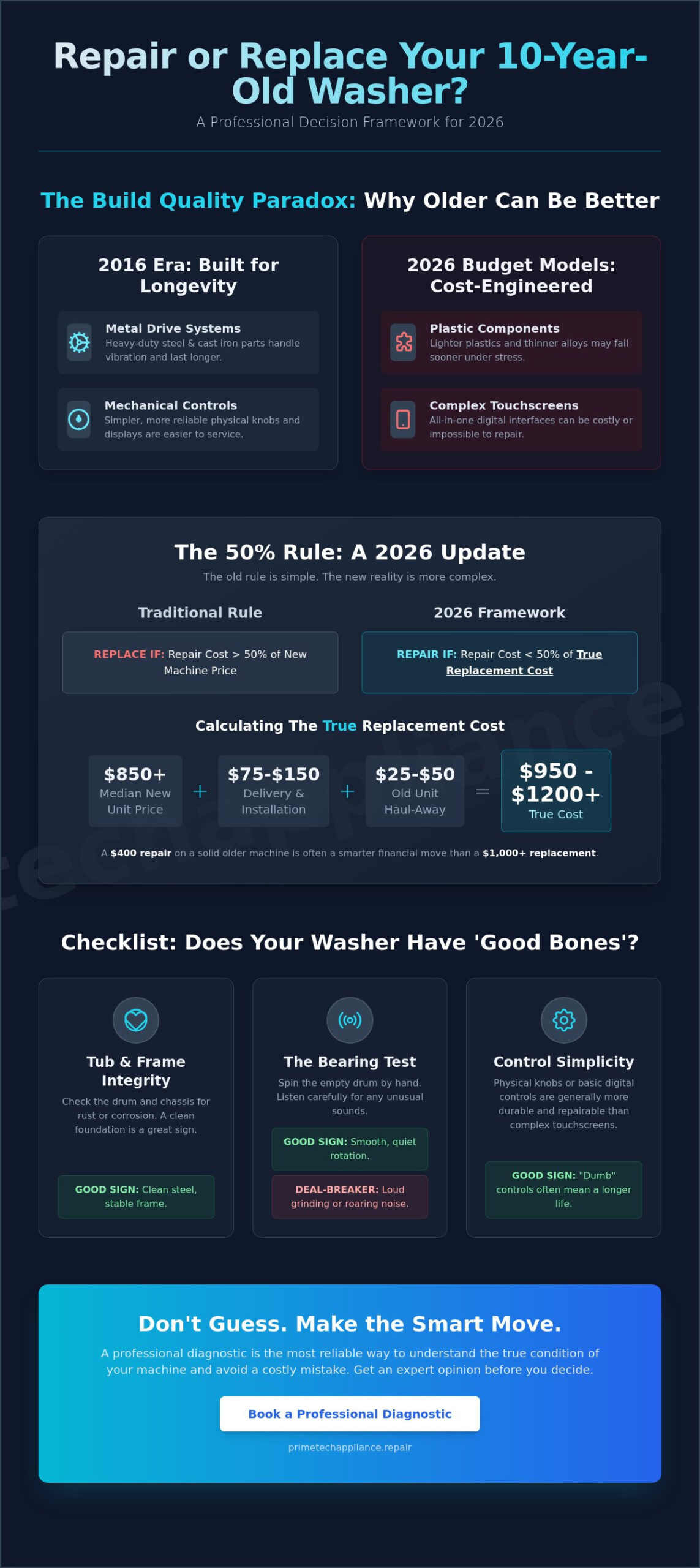
- Compare the durable metal drive systems of 2016-era models against the plastic components found in many modern entry-level units.
- Identify if your specific brand heritage supports a 20-year lifespan or if the machine has reached its projected mechanical limit.
- Use our professional checklist to decide is it worth repairing a 10 year old washing machine based on the specific component that failed.
- Understand why a professional diagnostic is the most reliable way to prevent a household crisis from becoming an expensive financial mistake.
Evaluating the 10-Year Milestone: Is Your Washer Truly at the End of the Road?
Ten years is the typical “mid-life crisis” for household appliances. It’s the point where a single mechanical failure forces a tough decision: reinvest in a proven machine or pivot to a new one. In 2026, this choice is more complex than it was just a few years ago. You aren’t just comparing a repair bill to a price tag; you’re weighing the reliability of older engineering against the potential fragility of modern units. Deciding is it worth repairing a 10 year old washing machine requires a clinical look at the machine’s history and current physical state.
Many experts refer to the mid-2010s as a high point for certain brands before planned obsolescence became more aggressive. While washing machine technology has advanced in terms of Wi-Fi sensors and complex cycle algorithms, the core mechanical parts like motors and transmissions were frequently more robust in 2016 models than in today’s entry-level units. If your machine has survived a decade with only minor issues, it likely possesses a build quality that is hard to find in a budget replacement today.
The 50% Rule in 2026: A New Financial Framework
The traditional advice says to replace an appliance if the repair costs more than half of a new unit. In 2026, this logic needs an update to account for the “true cost of replacement.” This includes delivery fees, haul-away charges for the old unit, and the rising median price of new machines, which now sits around $850. If a new, high-quality machine costs $1,200, spending a reasonable amount on a professional repair is often the superior financial move. It buys you several more years of service for a fraction of the total replacement investment.
Signs Your 10-Year-Old Washer Has ‘Good Bones’
Before you write off your machine, perform a quick physical audit to see if it’s a “hidden gem” worth saving. Look for these specific indicators of longevity:
- Tub Integrity: Open the door and inspect the drum and frame for rust. If the steel is clean and the chassis is stable, the machine’s foundation is solid.
- The Bearing Test: Spin the empty drum by hand. It should move smoothly and quietly. A loud grinding sound suggests failing bearings, which is often a deal-breaker.
- Control Simplicity: Machines with physical knobs or simple digital displays are often more reliable and easier to service than modern units with complex, all-in-one touchscreens.
Ask yourself three diagnostic questions before making a final call. Does the machine still clean clothes effectively when it runs? Is the current failure a common wear-and-tear part like a pump or belt? Have you maintained the unit properly over the last decade? If the answer to these is positive, your 10-year-old washer likely has plenty of life left.
The Build Quality Paradox: Why Older Might Be Better
You might feel pressured to upgrade to a sleek, Wi-Fi-enabled model with a touchscreen. However, there is a significant catch. Modern appliance manufacturing has shifted toward lighter, less durable materials to hit lower price points. When asking is it worth repairing a 10 year old washing machine, you must consider the “Build Quality Paradox.” A machine manufactured in 2016 often features internal components that outclass the entry-level models sitting on showroom floors in 2026. Older units were frequently engineered with a focus on mechanical longevity rather than digital gimmicks.
Repairing an existing unit is also the most responsible choice for the environment. In Orange County, keeping a heavy appliance out of the landfill prevents hundreds of pounds of waste. While new machines boast better energy ratings, they often have a shorter functional life. The average life expectancy of a new washing machine is approximately 11 to 12 years, but budget-tier modern units often fail much sooner. Keeping a “dumb” machine running is the ultimate green strategy for your home.
Metal vs. Plastic: The Hidden Decline in Durability
The biggest difference between your 10-year-old machine and a new budget model is what’s under the hood. Older units typically used cast iron or heavy-duty steel for motor mounts and drum supports. Many modern replacements use high-density plastic or thinner alloys. These materials save weight and cost, but they don’t handle the vibration of high-speed spin cycles as well over time. Your older machine’s heavy-duty cycle is likely more effective because it was designed to handle larger, unbalanced loads without the components flexing or warping. This high “Repairability Score” makes a decade-old machine a prime candidate for a professional tune-up.
The Software Trap in Modern Appliances
Modern washers are essentially computers that happen to clean clothes. While Wi-Fi connectivity and smart sensors sound convenient, they are expensive failure points. A single power surge can fry a control board that costs hundreds of dollars to replace. In contrast, 10-year-old legacy models rely on simpler electronic or mechanical timers. Parts for these machines remain widely available and are significantly more affordable than the proprietary sensors found in 2026 models. If you’re unsure about your unit’s internal condition, a quick professional washer inspection can reveal if your machine is a sturdy classic worth saving. Regular maintenance, such as cleaning the inlet screens and checking the drive belt, can easily push an older machine past the 15-year mark.
Luxury vs. Standard Models: Why Brand Heritage Changes the Math
Not all ten-year-old machines are created equal. While a budget unit from a big-box store might be nearing its mechanical limit, a precision-engineered luxury model is often just reaching its midpoint. When you ask is it worth repairing a 10 year old washing machine, the answer hinges heavily on the logo on the front panel. Standardized advice often fails to account for the massive gap in engineering quality between mass-market brands and premium manufacturers like Miele, Bosch, or Speed Queen. These high-end units are frequently designed for a 20-year service life, making a decade of use feel like a routine milestone rather than a terminal diagnosis.
In Orange County, we see many homeowners who chose luxury brands for their superior performance and durability. Protecting that initial investment is usually the smartest financial move. A high-end machine features industrial-grade components, such as stainless steel tubs and heavy-duty suspension systems, that far outlast the parts found in entry-level replacements. PrimeTech’s extensive experience with premium brand longevity confirms that these machines almost always justify a professional repair. You aren’t just fixing a fault; you are extending the life of a superior piece of technology.
Is Your Brand a ‘Lifer’ or a ‘Limited’?
Some brands are built to be “lifers.” Miele, Speed Queen, and Bosch reward owners who prioritize maintenance, as their internal structures are designed to withstand thousands of cycles without catastrophic failure. Conversely, entry-level domestic brands often enter a “danger zone” between years eight and ten, where multiple components may begin to fatigue simultaneously. Appliance Heritage serves as the definitive predictor of whether a specific repair will provide a long-term return on your investment. If your machine comes from a lineage of durability, the math usually favors the repair man.
Sourcing Parts for Discontinued 10-Year-Old Models
A common myth suggests that parts for older machines vanish from the market after a decade. This is rarely the case for established manufacturers. PrimeTech maintains direct access to manufacturer-approved parts for legacy units, even when those models are no longer in production. While a general handyman might struggle to find a specialized control module, our technical network ensures we can source the exact component required. High-end diagnostics require specialized labor and a deep understanding of complex European or heavy-duty domestic engineering. Our technicians possess the precision tools and expertise to handle these sophisticated systems, ensuring your washer continues to perform at its peak for years to come.
Common 10-Year Faults: Investments vs. Deal-Breakers
Mechanical failures aren’t all equal. Some issues are mere hiccups in a machine’s long life, while others signal a terminal decline. Before you decide is it worth repairing a 10 year old washing machine, you must distinguish between a simple component failure and a structural collapse. Identifying the source of the trouble helps you avoid the stress of a mounting laundry pile and ensures you don’t overspend on a “money pit” unit.
A leak, for instance, isn’t always a disaster. A small puddle on the floor might just be a cracked door seal or a loose internal hose. However, water leaking directly from the bottom of the outer tub usually points to a cracked drum or failed main seal. Understanding these nuances allows you to provide your technician with accurate information, leading to a faster and more efficient service call. If the machine still agitates and spins but simply won’t drain, you’re likely looking at a repairable investment rather than a replacement crisis.
The ‘Quick Fixes’ That Add 5 Years of Life
Many 10-year-old machines fail because of “wear and tear” parts that are specifically designed to be replaced. These repairs are high-impact and cost-effective:
- Drain Pump Replacement: If your washer stops with a tub full of water, the pump is likely the culprit. This is a straightforward swap that restores full functionality instantly.
- Drive Belt Service: Over a decade, rubber belts stretch or fray. A new belt prevents slipping and ensures the drum spins at the correct RPM.
- Inlet Valve Cleaning: Orange County’s hard water is notorious for mineral buildup. Calcium deposits can clog inlet valves, leading to slow fill times or no water at all. Replacing these valves is a low-cost way to improve performance.
If your machine is struggling with these specific issues, schedule a professional washer repair to get your household back on track today.
When to Say Goodbye: The Deal-Breaker Repairs
Some failures require such intensive labor that the repair bill becomes difficult to justify. The most common “death knell” is a failed main bearing. If your machine sounds like a jet engine taking off during the spin cycle, the bearings are likely seized. Replacing them requires a complete teardown of the machine, which often takes several hours of specialized labor. Transmission failures in older top-loaders present a similar challenge, as the part cost combined with the work hours often approaches the price of a mid-range new unit. The Point of No Return for washer repair is reached when the total cost of a single intervention exceeds 50% of the price of a comparable new machine while offering no guarantee against future component failure.
Professional Diagnostics in Orange County: Making the Smart Move
Making a snap decision to scrap your appliance often leads to unnecessary expenses and buyer’s remorse. A professional diagnostic fee is the most affordable insurance policy you can buy against a bad financial move. Instead of guessing is it worth repairing a 10 year old washing machine, you get a definitive answer based on the unit’s mechanical reality. Our technicians evaluate the total health of the machine, looking far beyond the immediate symptom to ensure a repair won’t be followed by a different failure next month.
PrimeTech brings a transparent, expert-led approach to every home in Orange County. We understand that a broken washer is a domestic emergency that disrupts your entire week. Our process focuses on providing a clear “Yes” or “No” based on the structural integrity of your specific model. If the machine has a high-quality drive system and clean bearings, we prioritize restoration. This “Repair over Replace” philosophy saves you from the cycle of buying lower-quality modern units that may not last five years.
Local Factors: How Orange County Water Affects Your 10-Year-Old Washer
Living in Orange County presents unique challenges for long-term appliance health. Our local water is notoriously hard, leading to significant mineral buildup on heating elements and internal rubber seals over a decade. These calcium deposits often cause inlet valves to seize or sensors to malfunction, which can mimic the signs of a catastrophic failure. National advice rarely accounts for this specific environmental stress. We tailor our preventative maintenance to combat local water conditions, often extending the life of a 10-year-old machine by several years with a targeted descaling and seal replacement. We stand behind this expertise with a 100% satisfaction guarantee on all our Orange County service calls.
Maintaining your home’s overall water health is just as important; for comprehensive plumbing and HVAC services, check out Anton Plumbing Heating & Cooling to keep your entire household running smoothly.
Ready for a Solution? What to Expect from PrimeTech
Our same-day diagnostic process is designed for speed and precision. When our technician arrives, they perform a comprehensive multi-point inspection of the motor, pump, and control systems. Please have your model number ready and ensure the area around the machine is clear for the quickest results. We provide a detailed estimate on-site, allowing you to make an informed choice without any hidden fees or high-pressure sales tactics. Stop the laundry backlog and get the expert clarity you need to move forward. Schedule your expert washer diagnostic in Orange County now and let us help you decide if your machine is a hidden gem worth saving.
Take Decisive Action on Your Laundry Crisis
Deciding is it worth repairing a 10 year old washing machine requires balancing mechanical reality against financial logic. You now understand that older metal drive systems often provide better longevity than modern plastic alternatives. You also know that luxury brand heritage can turn a decade-old unit into a high-value asset worth saving. Don’t let a mounting laundry pile force you into an expensive replacement you don’t actually need.
PrimeTech has served all of Orange County since 2019 with a commitment to integrity and technical precision. Our expert technicians for luxury brands evaluate your machine’s total health to provide a clear, honest recommendation. We back every service call with a 100% satisfaction guarantee to give you total peace of mind. Stop the guesswork and get your household back on track today.
Book Your Same-Day Washer Diagnostic with PrimeTech and restore the efficiency of your home with confidence.
Frequently Asked Questions
Is it worth fixing a 10-year-old washing machine that won’t drain?
Yes, a drainage failure is one of the most cost-effective repairs you can perform on a decade-old unit. When asking is it worth repairing a 10 year old washing machine, remember that these issues typically stem from a clogged drain pump or a worn drive belt. These components are accessible. Resolving the problem is often much cheaper than purchasing a new machine.
What is the average lifespan of a modern washing machine in 2026?
The average life expectancy of a modern washing machine in 2026 is approximately 11 to 12 years. This figure varies significantly based on the brand’s engineering quality and how well you maintain the unit. While entry-level models may struggle to reach the decade mark, high-end manufacturers often design their machines to provide 20 years of reliable service. Regular maintenance is the key to longevity.
How much does a typical washing machine repair cost in Orange County?
Repair costs in Orange County depend on the specific part that failed and the brand of your appliance. Labor rates in Southern California reflect the specialized expertise required for modern and luxury machines. We recommend scheduling a professional diagnostic. This gives you an accurate estimate tailored to your unit’s needs without relying on vague national averages that don’t reflect our local market.
Should I replace my washer if the control board is broken?
Replacing a control board on a 10-year-old machine is a complex decision that depends on the unit’s overall health. If the mechanical parts like the motor and drum are in excellent condition, a new board can extend the life of the machine significantly. Electronic components are expensive. You should weigh the cost against the price of a new high-efficiency model before proceeding with the repair.
Can hard water in Irvine or Newport Beach shorten my washer’s life?
Hard water in cities like Irvine and Newport Beach definitely accelerates the wear on internal washer components. Mineral deposits build up on heating elements, clog inlet valves, and degrade rubber seals over time. Regular descaling and professional maintenance are essential in these areas to prevent premature failure. These steps ensure your machine reaches its full life expectancy despite local water conditions.
Is it better to buy a new cheap washer or fix an old high-end one?
Fixing an old high-end machine is generally a better long-term investment than buying a new budget-tier model. High-end brands use superior materials, such as stainless steel and heavy-duty alloys, that outlast the plastic components found in entry-level units. Deciding is it worth repairing a 10 year old washing machine often comes down to the quality of the original engineering. A sturdy legacy unit often outperforms a flimsy new one.
What are the signs that my washing machine bearings are going bad?
The most common sign of failing bearings is a loud, rhythmic roaring or grinding sound during the high-speed spin cycle. You can also check for play in the drum by pushing it upward; any significant movement relative to the outer tub indicates the bearings have worn out. This repair requires a complete teardown. It is often considered a deal-breaker for older machines due to the high labor hours involved.
Does PrimeTech provide same-day washing machine repair?
Yes, we offer a same-day diagnostic process to address household emergencies quickly across Orange County. Our technicians arrive prepared to handle common failures immediately to minimize your downtime and get your laundry moving again. We prioritize speed. Clear communication ensures your repair experience is straightforward and stress-free.