

Your oven doesn’t just “break”; it stops following a logical sequence of mechanical events. When your dinner remains raw or the preheat light stays dark, the stress of ruined meals and safety concerns is immediate. Identifying common oven repair problems is the first step toward regaining control of your kitchen. You need a solution that prioritizes your family’s safety and your property’s value without the guesswork of DIY disasters or the fear of electrical fires.
We understand that a malfunctioning appliance feels like a household emergency. It’s frustrating to face uncertainty about gas leaks or the logic of technical failures. This guide provides a professional diagnostic roadmap for 2026, helping you pinpoint exactly why your unit is failing. You’ll learn when to attempt a quick fix and when it’s time to call a reliable local technician for a precise repair. We’ll explore how 2026 energy standards and manufacturer supply chain shifts affect your repair decisions, ensuring your kitchen returns to peak performance with total transparency.
Key Takeaways
- Master the operation sequence to quickly identify the root of common oven repair problems and avoid ruined meals.
- Learn to spot the subtle signs of a failing igniter or heating element before they lead to a complete system shutdown.
- Discover the critical difference between a faulty sensor and a board calibration issue for professional-grade brands like Wolf and Viking.
- Identify how mechanical wear on door hinges and electronic glitches in self-clean mode can impact your oven’s energy efficiency.
- Understand the importance of a logic-based diagnostic approach to ensure long-term reliability and peace of mind in your kitchen.
The Anatomy of Failure: Understanding How Your Oven Cycles
An oven doesn’t just turn on; it initiates a complex handshake between electronic and mechanical components. Every successful bake cycle relies on a precise sequence of operations. When this chain breaks, you encounter common oven repair problems that range from minor calibration errors to total system lockouts. Understanding how your oven cycles is the foundation of professional diagnostics. It moves you away from guessing and toward a logical resolution that preserves your appliance and your peace of mind.
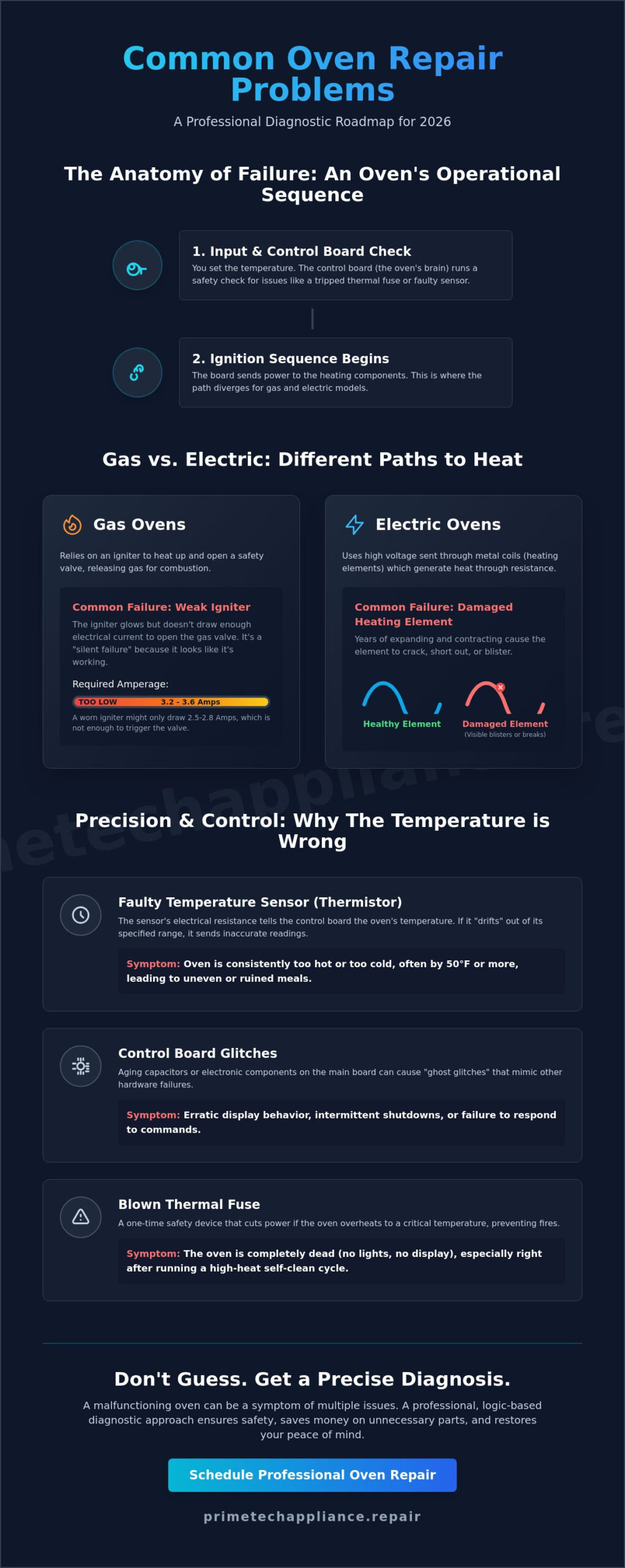
The process begins at the control board. This brain receives your input and immediately checks safety parameters. It queries the temperature sensor to determine the current internal environment. If the board detects an open circuit or a tripped thermal fuse, the cycle dies before it even starts. This protective logic prevents fires, but it’s also why a single failed sensor can render an expensive range useless. Understanding these logic gates is the key to efficient troubleshooting.
Gas vs. Electric: Different Paths to the Same Heat
Gas and electric ovens achieve high temperatures through vastly different methods. In a gas unit, the control board sends power to an igniter. This glow bar must reach a specific amperage to trigger the safety valve and release gas. If the igniter glows but doesn’t get hot enough, the oven won’t light. This is one of the most frequent common oven repair problems for gas models. Some modern units use a spark ignition system, which relies on a high-voltage pulse rather than a heating element.
Electric ovens rely on resistance. The board closes a relay, sending high-voltage current through metal coils. As the current fights through the internal resistance of the element, it generates heat. While durable, these elements eventually crack or short out due to years of thermal expansion. If you see visible blisters or dark spots on your bake element, it’s already failing. These failures are usually straightforward to diagnose but require immediate attention to prevent damage to the control board.
The Role of the Thermostat and Control Board
Modern ovens use a thermistor, which is a sensor whose electrical resistance changes based on temperature. The control board monitors this resistance constantly. If the sensor drifts out of its specified range, your oven might run 50 degrees too hot or cold. This isn’t always a broken oven; it’s often a calibration error. However, ghost glitches can also occur when the board’s capacitors wear out, causing intermittent reboots or erratic display behavior that mimics hardware failure.
The board also monitors the thermal fuse. This is a one-time safety device designed to blow if the oven exceeds a critical temperature threshold. If your oven is completely dead after a high-heat self-clean cycle, the thermal fuse is the primary suspect. We focus on these root causes to ensure a permanent fix rather than just swapping parts. A professional diagnostic ensures that every safety limit and electronic signal is functioning as the manufacturer intended.
Heating and Ignition: Why Your Oven Stays Cold
A cold oven is a mechanical betrayal that stops your household routine in its tracks. While your digital display might show the correct time and settings, the lack of heat indicates a fundamental breakdown in the ignition sequence. Heating and Ignition: Why Your Oven Stays Cold often involves components that appear functional but lack the electrical integrity to perform. Identifying these nuances is the first step in solving common oven repair problems before they escalate into safety hazards.
The most deceptive failure in a gas oven is the “silent failure” of the igniter. Many homeowners assume that if the igniter glows, it’s working. This is a common diagnostic error. A professional-grade igniter must draw a specific amperage, typically between 3.2 and 3.6 amps, to signal the safety valve to release gas. As igniters age, their resistance increases. They may still glow bright orange, but they fail to reach the electrical threshold required to open the valve. This results in a cold oven and a significant amount of wasted time.
For residents in coastal Orange County, environmental factors play a unique role in appliance longevity. Salt-heavy air can lead to rapid corrosion of ignition contacts and wiring terminals. This oxidation creates intermittent connectivity issues that are less common in inland areas. If your unit struggles to ignite specifically on humid or foggy days, surface corrosion on the igniter or safety valve terminals is likely the culprit. Maintaining clean electrical paths is vital for consistent performance in these microclimates.
Gas Oven Ignition Problems
If you hear your gas range clicking repeatedly without a flame, the spark electrode is likely misaligned or covered in grease. However, a more pressing concern is “delayed ignition.” This occurs when gas accumulates in the chamber before finally igniting with a loud, startling “boom.” This is frequently caused by clogged burner ports or a weak igniter that takes too long to reach temperature. If you experience this, stop using the appliance immediately. A quick consultation with a professional oven repair technician can ensure your gas pressure and ignition timing are within safe manufacturer specifications.
Electric Element Burnouts
Electric ovens offer a more visual diagnostic path, but the failures are no less frustrating. You should regularly inspect your bake and broil elements for the following visual cues:
- Hot Spots: Areas of the coil that glow significantly brighter than the rest.
- Blisters: Bubbles or rough patches on the black protective sheath.
- Visible Cracks: Any break in the element’s surface that exposes the internal filament.
Often, only the bake element fails, leaving you with a functional broiler but an oven that cannot sustain a consistent temperature. Beyond physical wear, sudden power surges can fry the relays on the control board, preventing power from reaching even a brand-new element. Testing for electrical continuity with a multimeter is the only way to confirm if you are dealing with a simple element swap or a complex board failure.
Precision and Calibration: Addressing Uneven Cooking
Uneven cooking is a subtle failure that ruins expensive ingredients and holiday meals. While your oven may eventually reach the set temperature, how it maintains that heat determines the quality of the result. Among the Common Oven Problems, calibration drift is particularly prevalent in high-end appliances like Wolf, Viking, and Thermador. These units are designed for professional-grade precision. When they vary by even 15 degrees, the logic of the entire bake cycle is compromised. Addressing these common oven repair problems requires a balance of electrical testing and mechanical inspection.
Before assuming a major mechanical failure, perform the “Oven Thermometer Test.” Place a reliable analog thermometer in the center of the middle rack. Set your oven to 350 degrees and wait for the preheat signal. Monitor the temperature over three cycles as the heating elements kick on and off. If the average temperature deviates by more than 20 degrees from your setting, you are facing common oven repair problems related to sensor accuracy or board logic. This simple verification helps distinguish between a user error and a genuine hardware malfunction.
Temperature Sensor Diagnostics
The temperature sensor is a thermistor that provides a specific resistance reading to the control board. At room temperature, most sensors should read approximately 1,080 to 1,100 Ohms. If the resistance is outside this range, the board receives the wrong data and incorrectly adjusts the heat. Sensors can drift over time due to thermal fatigue or even improper positioning. Ensure the sensor probe is not touching the oven wall. Metal-to-metal contact causes false readings and leads to undercooked meals or scorched surfaces.
Convection Fan and Airflow Issues
Heat distribution is just as critical as heat generation. In convection models, a failing fan motor creates “cold pockets” where air remains stagnant. Listen for grinding, squealing, or rattling noises during the cycle. These sounds often signal worn-out bearings in the fan motor or a loose mounting bracket. High-end dual-convection systems require professional balancing to ensure both fans work in harmony. If the baffle or fan blade is bent, the airflow pattern is disrupted. This leads to uneven browning even if the temperature sensor is perfectly calibrated. Professional intervention ensures the motor is drawing the correct voltage and the airflow is unobstructed.
Mechanical and Electronic Glitches: Doors and Boards
The interaction between physical hardware and electronic logic is where most common oven repair problems begin. A modern oven relies on a series of safety checks before it allows the heating elements to engage. If a single mechanical latch or electronic sensor fails, the entire system enters a protective lockout. This is especially evident during the self-clean cycle. A malfunctioning door latch assembly is more than a nuisance; it’s a safety lockout. During self-cleaning, the oven reaches temperatures exceeding 800 degrees. The control board will not begin this process unless the door latch is physically engaged and electronically verified. If the latch motor fails or the housing warps, your oven may remain locked indefinitely, even after the unit cools down.
Worn-out door hinges are another subtle culprit behind poor performance. Hinges are under constant tension and eventually lose their ability to pull the door flush against the frame. This creates a gap that allows heat to escape, forcing the oven to cycle more frequently to maintain temperature. This extra work shortens the lifespan of your heating elements and sensors. If you notice your kitchen getting unusually hot while the oven is on, your hinges are likely the root cause. Addressing these common oven repair problems early prevents more expensive electronic failures down the line.
Door Seals and Hinge Alignment
The ‘Paper Test’ is your fastest diagnostic tool for door integrity. Close the oven door on a single sheet of paper. If you can pull the paper out with no resistance, your gasket is compressed or your hinges are misaligned. This failure does more than waste energy. When heat escapes from the top of the door, it flows directly into the control panel. This constant thermal stress causes the solder joints on the circuit board to crack and the touchpad to delaminate. Replacing hinges is often more effective than replacing the entire door assembly, as it restores the original factory seal and protects your electronics.
Control Board and Touchpad Failures
Control boards are the most expensive components in a modern oven. Heat is their primary enemy. If your touchpad buttons are unresponsive or the display shows erratic “F-codes,” you are likely dealing with a shorted circuit or a failed relay. These error codes are the oven’s internal diagnostic language, pointing to specific communication failures between the board and the hardware. DIY control board repair on luxury models is risky; static electricity or incorrect voltage can easily fry sensitive microprocessors. For a definitive resolution and a guaranteed fix, trust our experts for professional oven repair to restore your appliance’s brain to full health.
Professional Oven Repair in Orange County: The PrimeTech Approach
Resolving common oven repair problems requires more than a standard toolbox; it demands an analytical mindset and technical precision. In Orange County, where high-end kitchens are the standard, residents in Irvine and Newport Beach need a service partner who understands the intricate logic of luxury brands. We specialize in the sophisticated engineering of Sub-Zero, Wolf, and Viking appliances. Our diagnostic process focuses on identifying the root cause of a failure rather than just treating the symptom. This professional approach prevents repeat breakdowns and ensures your kitchen remains a safe, functional environment for your family.
Safety is our non-negotiable priority. Modern ovens operate on 240V electrical circuits or high-pressure gas lines. These systems present significant risks, including electrical fires and gas leaks, if handled by an untrained individual. A professional technician possesses the specialized equipment to test gas pressure and electrical load with absolute accuracy. We verify that every connection meets strict safety codes before we consider the job complete. This commitment to excellence provides the peace of mind you deserve during a household crisis.
Same-Day Solutions for Orange County
We recognize that a broken oven is a major disruption to your daily life. Our team maintains a strong presence throughout Huntington Beach, Santa Ana, and the surrounding communities to provide rapid response times for kitchen emergencies. We arrive with a strategic inventory of high-quality components to address common oven repair problems in a single visit whenever possible. You can expect transparent communication regarding our findings and a commitment to a 100% satisfaction guarantee. We value your time and property, ensuring a clean and efficient service experience from start to finish.
Why Professional Repair Beats Replacement
Deciding whether to fix or replace an appliance is a significant financial choice. High-end ovens are engineered for longevity, often providing 15 to 20 years of service with professional maintenance. Repairing a premium unit is almost always more cost-effective and environmentally responsible than disposal. By choosing a precision repair, you extend the life of your investment and avoid the massive expense and disruption of a full kitchen remodel. Modern replacement parts often feature improved designs that solve original factory weaknesses. Schedule your expert oven diagnostic today to receive an honest, expert assessment of your appliance’s health and performance.
Restore Your Kitchen’s Performance Today
Managing common oven repair problems doesn’t have to be a source of household stress. By understanding the mechanical handshake between your control board and heating components, you move from uncertainty to a clear resolution. You’ve learned that a glowing igniter isn’t always functional and that simple door hinge misalignment can compromise your entire electronic system. These professional insights help you protect your investment and maintain the high standards of your home.
Don’t let a malfunctioning appliance ruin another meal or compromise your family’s safety. Our licensed and insured technicians specialize in high-end brands like Viking and Wolf, ensuring your luxury equipment receives precision care. We prioritize your property with efficient diagnostics and reliable solutions that last. Book Your Same-Day Oven Repair in Orange County to access expert service in Irvine and the surrounding areas. We’re ready to get your kitchen back to peak performance right now.
Frequently Asked Questions
Why is my gas oven clicking but not lighting?
The clicking sound indicates the spark electrode is firing, but the gas isn’t igniting due to a dirty burner or a faulty safety valve. Grease buildup often clogs the burner ports, preventing the gas from reaching the spark. If the ports are clear, the issue usually lies with the igniter’s inability to draw enough amperage to open the gas valve. This is a primary example of common oven repair problems that require professional electrical testing to resolve safely.
How do I know if my oven heating element is burnt out?
A burnt-out element usually shows physical damage like blisters, cracks, or visible “hot spots” where the coil glows unevenly. If the element looks intact but remains cold, it likely has an internal break in the circuit. You can verify this by testing for continuity with a multimeter. If the circuit is open, the element must be replaced to restore the oven’s heating capability and ensure even browning.
Is it worth repairing an oven that is 10 years old?
Repairing a 10-year-old oven is generally worth it if the repair cost is less than 50% of the price of a comparable new model. High-end brands like Wolf and Viking are built for much longer lifespans, often reaching 20 years with proper professional maintenance. Consider the unit’s overall mechanical condition and whether it meets your current energy efficiency needs before deciding to invest in a repair or a replacement.
Why does my oven take so long to preheat?
Slow preheating is typically caused by a weakening bake element or a failing gas igniter that takes too long to trigger the gas valve. In electric models, if the hidden bake element fails, the oven relies solely on the broil element. This is significantly less efficient for heating the entire cavity. Replacing these worn components restores the brisk, logical heating rhythm your kitchen requires for efficient meal preparation.
Can I use my oven if the glass door is cracked?
No, you should not operate an oven with a cracked glass door because it compromises both safety and heat retention. The inner glass is designed to withstand extreme thermal stress, and a crack can lead to a complete shatter during a high-heat cycle. Heat escaping through the crack can also damage your control panel and surrounding cabinetry, leading to much more expensive common oven repair problems.
What does an F97 error code mean on my oven?
An F97 error code usually indicates a failure in the cooling fan circuit or a communication error between the control board and the fan motor. This fan protects the sensitive electronics from overheating during use. If the fan fails to reach the required RPM, the system will lockout to prevent permanent damage to the microprocessors. A technician will check the fan’s power supply and the board’s relay to clear the code.
How much does the average oven repair cost in Orange County?
National data shows that average oven repairs range from $136 to $346, though local rates in Orange County vary based on the complexity of the diagnostic. You should check for a flat-rate diagnostic fee that includes the initial inspection of your specific model. Factors such as parts availability and the specific technology of your appliance brand will influence the final investment required to restore functionality.
Why is my oven blowing cold air during the bake cycle?
Blowing cold air indicates that the convection fan is running, but the heating elements have failed to engage. This often happens when a thermal fuse has tripped or a relay on the control board has shorted out. The system thinks it’s heating, but the electrical “handshake” between the board and the element is broken. Professional diagnostic equipment is necessary to trace the voltage and find exactly where the signal is being interrupted.