
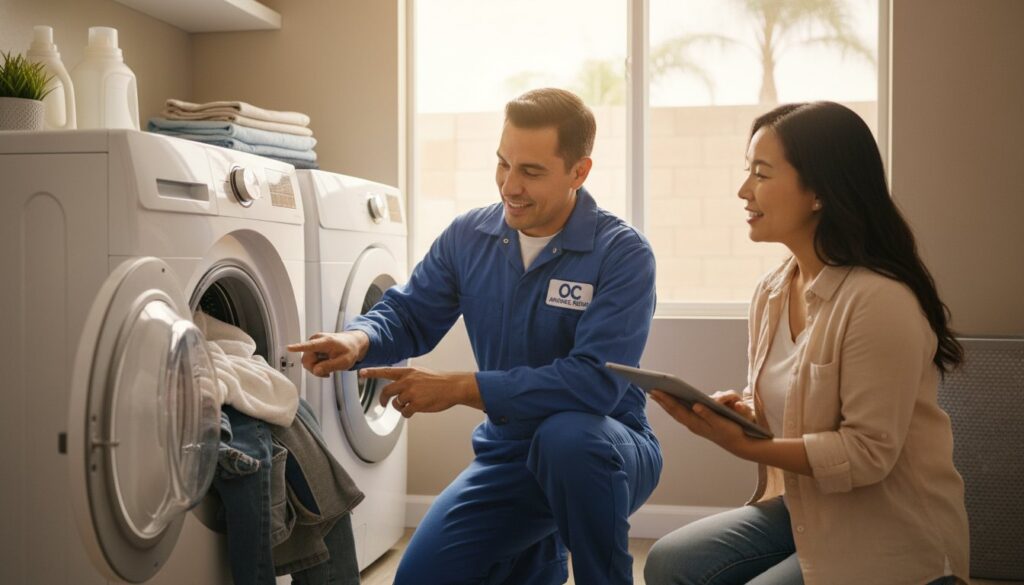
You reach into the drum to move a load to the dryer, only to find a heavy, dripping mess of clothes because your washing machine won’t spin in Anaheim. It’s a frustrating disruption that always seems to happen when your schedule is at its busiest. You’re likely worried about the mounting pile of wet laundry and the potential for a massive repair bill. We understand that a broken appliance is more than a minor inconvenience; it’s a direct threat to your household’s productivity and peace of mind.
You don’t have to face a week of laundromat trips or guess at the cause of the breakdown. This guide helps you identify exactly why your washer stopped spinning and reveals the fastest way to get your laundry routine back on track with confidence. We focus on providing the transparency you need to make an informed decision about your home’s maintenance while ensuring your machine is ready for years of heavy use.
We’ll break down the common mechanical failures that plague local machines, explain how Anaheim’s specific environment impacts your hardware, and provide the clear steps needed to secure a reliable, long-term fix today. Discover how to transition from a sodden mess of clothes to a perfectly functioning laundry room without the stress of hidden costs or recurring failures.
Key Takeaways
- Perform immediate DIY checks on your power supply and drum balance to rule out simple operational errors before seeking professional help.
- Identify the primary mechanical culprits, such as snapped drive belts or worn motor couplings, when your washing machine won’t spin in Anaheim.
- Learn how local factors like inland heat and hard water mineral deposits specifically target and degrade your washer’s internal components.
- Use the “50% Rule” to calculate whether repairing your existing appliance or purchasing a new unit offers the best long-term value.
- Access rapid expert diagnostics to restore your laundry routine quickly, ensuring your high-end or standard washer receives brand-specific care.
Quick DIY Checks When Your Washer Stops Spinning
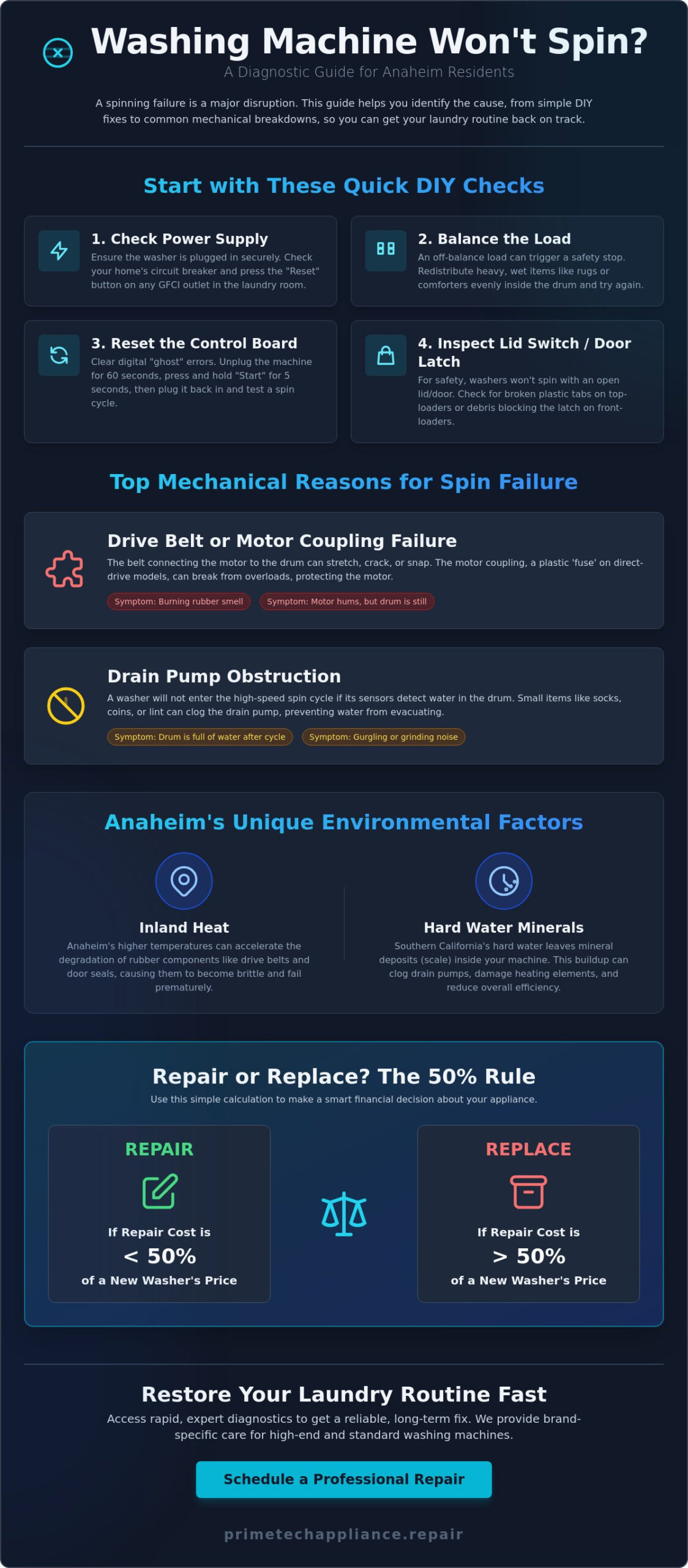
Before you commit to a service call, run through these essential diagnostic steps. Often, the reason a washing machine won’t spin in Anaheim is a simple safety trigger or a temporary software hang rather than a total mechanical failure. Start with the most basic element: power. Verify that the machine is receiving a consistent 120v flow from the outlet. Check your home’s circuit breaker panel and ensure the dedicated washer circuit hasn’t tripped. If your laundry room uses a GFCI outlet, press the “Reset” button on the faceplate to restore the connection. A loose plug or a tripped breaker is a common culprit in many domestic emergencies.
Next, address the physical load inside the drum. Modern appliances use sophisticated sensors to monitor drum balance throughout the cycle. If you’re washing a single heavy item like a dense rug or a large comforter, the machine may halt the spin cycle to protect the internal suspension. Open the lid, redistribute the wet laundry evenly around the agitator or drum, and try the cycle again. Gaining a basic understanding of how washing machines work reveals that the spin phase is the most taxing part of the process. If the load is off-center, the centrifugal force can cause the machine to shake violently, so the control board simply shuts the motor down as a precaution.
Resetting the Control Board
Modern washers operate using complex electronic control boards that can occasionally trap “ghost” error codes. These are digital hiccups that prevent the spin cycle from initiating even if the mechanical parts are healthy. To clear these, perform a master reset. Unplug the unit from the wall for sixty seconds. While the power is disconnected, press and hold the “Start” button for five seconds to drain any residual electricity from the capacitors. Plug the unit back in and attempt a “Drain and Spin” cycle. If the drum engages, you’ve successfully bypassed a software glitch. If the machine remains unresponsive, the failure is likely hardware-based.
Checking the Lid Switch and Door Latch
The lid switch is the primary safety component responsible for spin failures in top-loading machines. This switch confirms the lid is closed before the motor is allowed to reach high speeds. Inspect the plastic tab on the underside of your lid. If it’s chipped, bent, or missing, the switch won’t engage. You can test this by pressing the switch manually with a blunt tool; you should hear a crisp, audible click. For front-loading models, examine the door latch assembly for lint buildup or physical misalignment. If the door doesn’t lock securely, the control board will never trigger the spin sequence. If your washing machine won’t spin in Anaheim after these checks, it’s time to look at deeper mechanical components like belts and motors.
4 Common Mechanical Reasons Your Washer Won’t Spin
When basic troubleshooting fails, the problem usually lies within the core mechanical assembly. A washing machine won’t spin in Anaheim for several specific hardware reasons that require a more technical approach. Identifying these failures early can prevent collateral damage to the motor or transmission. Mechanical issues often present with specific sounds or smells that serve as early warning signs for homeowners.
Drive Belt and Motor Coupling Failure
The drive belt is a frequent point of failure in many top-loading machines. Over time, rubber belts stretch, crack, or snap entirely. If you detect a distinct smell of burning rubber during the cycle, the belt is likely slipping against the pulley, creating intense friction heat. A slipped belt might cause a slow, weak spin, while a snapped belt leaves the drum completely motionless despite the motor running.
In many direct-drive models, the motor coupling serves as a mechanical “fuse.” This small plastic and rubber component connects the motor to the transmission. It’s designed to fail if the machine is overloaded, protecting the expensive drive motor from burning out. If the coupling breaks, you’ll hear the motor humming, but the agitator and drum will remain still. Deciding whether to Repair or replace your unit often depends on the age of these internal parts and the overall condition of the transmission.
Drain Pump Obstructions
A washer won’t initiate a high-speed spin until the sensors confirm the water has been evacuated. The weight of the water creates too much resistance for the motor to overcome safely. If a stray coin, hair tie, or baby sock bypasses the drum and enters the drain lines, it can jam the pump impeller. This physical blockage halts the entire sequence and leaves your clothes sitting in a pool of gray water.
Many modern front-loaders feature an accessible pump filter at the bottom of the unit. Cleaning this filter is a vital maintenance task that can prevent major service calls. If the pump is clear but the water remains, the pump motor itself may have failed electrically. If you’re dealing with a flooded drum, a professional washer repair specialist can safely drain the unit and clear the obstruction before the water causes mold issues.
Faulty Motor Control Boards
The motor control board is the digital command center that regulates voltage to the drive motor. If the board’s relays or resistors fail, the motor won’t receive the signal to turn. This is often caused by power surges or heat-induced wear on the solder joints. While mechanical parts like belts show visible wear, a failed control board requires a multimeter to diagnose correctly. Understanding these common failures helps you communicate effectively with a technician when your washing machine won’t spin in Anaheim.
Why Anaheim Washers Face Unique Spinning Issues
Living in Orange County brings specific environmental challenges that directly impact your appliance’s lifespan. If your washing machine won’t spin in Anaheim, the cause might be tied to the local climate or infrastructure rather than just mechanical wear. Unlike coastal cities, Anaheim’s inland position creates a harsher environment for the rubber and plastic components found inside your washer. These factors often accelerate the need for professional intervention.
The Impact of Local Hard Water
Anaheim’s water supply is characterized by high mineral content, typically ranging between 200 and 300 parts per million (ppm). This hard water contains significant levels of calcium and magnesium. Over time, these minerals precipitate out of the water and form a rock-hard scale on your washer’s heating elements, drain pump impellers, and valves. This buildup creates excess friction, forcing the motor to work harder and eventually causing it to overheat or seize during the spin cycle.
Residents should consider descaling their machines annually to prevent these deposits from clogging the pressure switch hose. This tiny tube tells the control board how much water is in the drum. If mineral scale blocks the hose, the machine may think it’s still full of water and refuse to engage the spin cycle. Regular maintenance helps ensure these sensitive sensors remain clear and functional. If the scale has already caused a mechanical jam, a technician can disassemble the pump to clear the obstruction safely.
Heat and Component Degradation
Inland heat in Anaheim frequently reaches high temperatures, especially for machines located in garages or poorly ventilated laundry rooms. This intense OC climate accelerates the drying and cracking of rubber drive belts. When a belt loses its elasticity due to heat, it slips on the pulley system, preventing the drum from reaching the high RPMs needed to extract water. Plastic components also become brittle under these conditions, leading to snapped latches and cracked pump housings.
Protect your electronics by keeping your laundry area well-ventilated. High ambient temperatures can cause the capacitors on your motor control board to fail prematurely. If your laundry room feels like a sauna, your washer’s digital brain is at risk. Additionally, older Anaheim neighborhoods may experience power fluctuations that stress these sensitive circuits. Using a high-quality surge protector specifically for large appliances can prevent a costly control board failure when your washing machine won’t spin in Anaheim. Addressing these local factors early can extend the life of your appliance by years and prevent the frustration of wet, heavy laundry.
Repair or Replace? Calculating the Value for Your Home
Deciding the fate of a broken appliance requires a logical assessment of its remaining utility. When your washing machine won’t spin in Anaheim, the first instinct is often to browse for new models, but restoration is frequently the more strategic choice. Apply the “50% Rule” to your situation: if the estimated repair cost exceeds half the price of a comparable new unit, replacement is often the prudent path. For many mid-range and luxury machines, a professional fix costs significantly less than a total replacement, especially when the unit is less than a decade old.
Restoring a well-built machine also offers significant environmental and practical benefits. Modern manufacturing often favors “disposable” components that have shorter lifespans than machines built just ten years ago. By opting for a repair, you keep heavy machinery out of California landfills and maintain a unit that may actually be more durable than its newer counterparts. A professional diagnosis removes the guesswork, ensuring you don’t waste money on a replacement when a simple part could provide years of additional service.
Longevity of High-End Units
Luxury brands are engineered for 15 to 20 years of continuous service, making them excellent candidates for repair. These units utilize precision-machined parts and heavy-duty bearings that justify the cost of a mid-life restoration. Unlike budget models, premium washers often have a robust supply chain for precision parts, ensuring that a fix today won’t be compromised by low-quality components. Professional maintenance on these premium investments ensures they continue to operate at peak efficiency, protecting your initial high-dollar investment for the long term.
The Hidden Costs of New Installations
The sticker price of a new washer is rarely the final cost you’ll pay. Factor in delivery fees, professional installation, and the disposal of your old unit. Newer models often require specific plumbing adjustments or different electrical configurations that can drive up the total investment. There is also a learning curve associated with new digital interfaces and cycle settings that can disrupt your household routine. In many cases, the most efficient way to get back to normal is to book a professional washer repair to restore the machine you already know and trust.
A professional diagnosis is almost always cheaper than the “guess-and-check” method of DIY parts swapping. When your washing machine won’t spin in Anaheim, an expert can pinpoint the exact failure, preventing you from buying unnecessary components. This technical precision ensures the fix is definitive, providing you with the confidence that your laundry routine will remain uninterrupted for years to come.
Professional Washer Repair Services in Anaheim
A laundry backlog creates immediate stress for any active household. When your washing machine won’t spin in Anaheim, you need a solution that prioritizes both speed and technical precision. Domestic emergencies don’t follow a convenient schedule, and wet clothes sitting in a drum can quickly lead to mold and odors. Our team responds with the urgency your situation demands, providing professional intervention that restores order to your home. We combine local Orange County expertise with a commitment to punctuality and integrity, ensuring your property is respected throughout the entire repair process.
Navigating the 2026 appliance landscape requires a technician who understands both mechanical hardware and digital control systems. With the implementation of California’s AB 628, the reliability of household appliances has become a matter of legal habitability for many residents. We stay current with all state registration requirements through the Bureau of Electronic and Appliance Repair. This dedication to professional standards ensures that every service call is handled by a qualified expert who values long-term results over quick, temporary fixes.
The PrimeTech Advantage in Anaheim
Our technicians arrive prepared to resolve the issue on the first visit. We maintain a mobile inventory of high-failure components like drive belts, lid switches, and drain pumps. This proactive approach eliminates the need for multiple appointments and minimizes your machine’s downtime. Whether you own a standard mass-market model or a high-end luxury unit, we utilize sophisticated diagnostic tools to pinpoint the failure. We understand the specific engineering of brands like Whirlpool, LG, and Samsung, as well as the intricate electronics of premium manufacturers. This specialized knowledge ensures your appliance receives the exact care it requires to function at peak performance.
Schedule Your Same-Day Diagnostic
Transparency is the foundation of our service. During a service call, our expert performs a comprehensive inspection to identify the root cause of why your washing machine won’t spin in Anaheim. We provide a clear, upfront estimate before any work begins. You’ll never face hidden fees or surprise charges. Our repairs are backed by a satisfaction guarantee on both labor and parts, giving you the peace of mind that the fix is permanent. We value your time and aim to get your laundry routine back on track immediately. Don’t let a mechanical failure disrupt your week. Book your Anaheim washer repair with PrimeTech now and experience the reliability of a true local expert.
Restore Your Laundry Routine Today
A broken appliance doesn’t have to be a permanent disruption. We’ve explored how simple DIY resets can resolve minor glitches and why Anaheim’s specific environment, from high mineral deposits to intense inland heat, requires a targeted approach to maintenance. Applying the 50% Rule ensures you make the most cost-effective decision for your home, protecting your investment in high-quality hardware rather than settling for a shorter-lived replacement. Understanding these mechanical and environmental factors gives you the control to resolve domestic emergencies with confidence.
When your washing machine won’t spin in Anaheim, immediate action prevents laundry backlogs and potential water damage. Our team provides same-day service in Orange County, backed by a 100% satisfaction guarantee. Our expert technicians are specifically trained to handle high-end brands with precision and care. You deserve a functional home and transparent service that respects your time and property. Schedule Your Expert Washer Repair in Anaheim Today and get your household back on track. We’re ready to provide the reliable, long-term solution you need right now.
Frequently Asked Questions
How much does it usually cost to fix a washer that won’t spin in Anaheim?
Repair costs vary based on the specific component failure and the brand of your appliance. Major parts like motors or control boards typically represent a higher investment than minor fixes like door latches or drive belts. A professional diagnostic fee is usually applied toward the final repair cost if you proceed with the service, ensuring you receive a definitive fix without overpaying for unnecessary parts.
Can I still use my washer if it won’t spin?
You should stop using the appliance immediately if it fails to spin. Continuing to run cycles can strain the drive motor and potentially lead to a complete transmission failure or an internal flood. It’s safer to leave the unit unplugged until a technician can verify the integrity of the drive system and safety sensors. This prevents a manageable mechanical issue from turning into a total loss.
Why is my washer making a loud noise but not spinning?
A loud grinding or squealing noise often points to worn tub bearings or a failing drive belt. If your washing machine won’t spin in Anaheim, these sounds indicate that the mechanical components are struggling against excess friction. Addressing these noises early prevents the motor from burning out due to the added resistance. Our experts can quickly identify whether the sound is coming from the pump or the transmission.
How long does a typical washing machine repair take?
Most professional repairs are completed within one to two hours once the technician arrives on-site. We carry common replacement parts in our service vans to ensure we can resolve the issue during the initial visit. If a specialized part for a luxury model is required, we prioritize rapid sourcing through our network of local suppliers to minimize your household’s downtime and get you back to your routine.
Do you offer same-day appliance repair in Anaheim?
Yes, we prioritize urgent laundry emergencies and offer same-day service availability throughout the city. We understand that a broken washer disrupts your entire household schedule and creates an immediate crisis. Our local technicians are stationed across Orange County to ensure a rapid response time when your washing machine won’t spin in Anaheim, providing expert solutions right when you need them most.
Is it worth repairing a 10-year-old washing machine?
Repairing a decade-old machine is often worth the investment, particularly for high-end brands engineered for twenty-year lifespans. We recommend applying the “50% Rule” to your decision. If the professional repair cost is significantly less than half the price of a new unit, restoration is the smarter financial and environmental choice. Many older machines are built with more durable internal components than modern budget models.
What brands of washing machines do you repair in Orange County?
Our technicians are trained to service a wide spectrum of manufacturers, including industry leaders like Whirlpool, Samsung, LG, GE, and Maytag. We also possess the specialized diagnostic tools required for premium luxury brands. Our expertise covers both standard top-loaders and high-efficiency front-loading models across all of Orange County, ensuring we can handle the specific technology of your particular appliance regardless of its age.
What happens if my washer won’t spin or drain?
If your washer fails to both drain and spin, the culprit is almost always a clogged or failed drain pump. The machine’s control board will not trigger the spin cycle if the sensors detect water remaining in the drum. This safety feature prevents the unit from spinning at high speeds with the heavy weight of undrained water. A technician can safely drain the unit and clear any physical obstructions from the pump impeller.