
Your dryer is running and the drum is spinning, but after forty minutes, your clothes are still cold and damp. Dealing with a dryer not getting hot santa ana residents often find themselves stuck in a loop of wasted cycles and growing anxiety over potential lint fire hazards. It is a common household crisis that stalls your daily routine and leaves you guessing about the technical differences between a blown thermal fuse and a faulty gas igniter.
We understand that you need your laundry dry in one cycle without the frustration of damp fabrics piling up. You deserve a clear understanding of what is wrong and exactly what it will take to fix it. This guide identifies the specific reasons why your heat has failed and outlines the fastest path to professional repair right here in Orange County. We will explore the technical causes behind these malfunctions, from heating elements to cycling thermostats, and provide the logical steps to restore your appliance to peak efficiency. Whether you are a homeowner or a landlord navigating updated California habitability standards, getting your machine back in service is our priority.
Key Takeaways
- Identify the specific symptoms of a “no-heat” failure where the drum spins but the heating circuit remains inactive.
- Distinguish between electric heating coils and gas burner igniters to understand which technical components are most likely to fail in your specific model.
- Execute a rapid two-step troubleshooting check to rule out simple power supply issues or exterior vent obstructions.
- Discover the fastest route to professional restoration for a dryer not getting hot santa ana with reliable, same-day repair solutions.
- Learn how professional annual maintenance and vent cleaning can prevent future breakdowns and protect your home from fire hazards.
Why Your Dryer Stopped Heating: Common Santa Ana Scenarios
When you face a dryer not getting hot santa ana weather often plays a silent but significant role. A “no-heat” failure is a specific mechanical state where the motor hums and the drum spins, but the air inside remains room temperature. This happens because the heating circuit has been interrupted, even while the mechanical drive system functions perfectly. It is a common point of confusion for homeowners who assume a spinning drum means the entire appliance is healthy. In reality, the heating system is a separate chain of components that can fail independently.
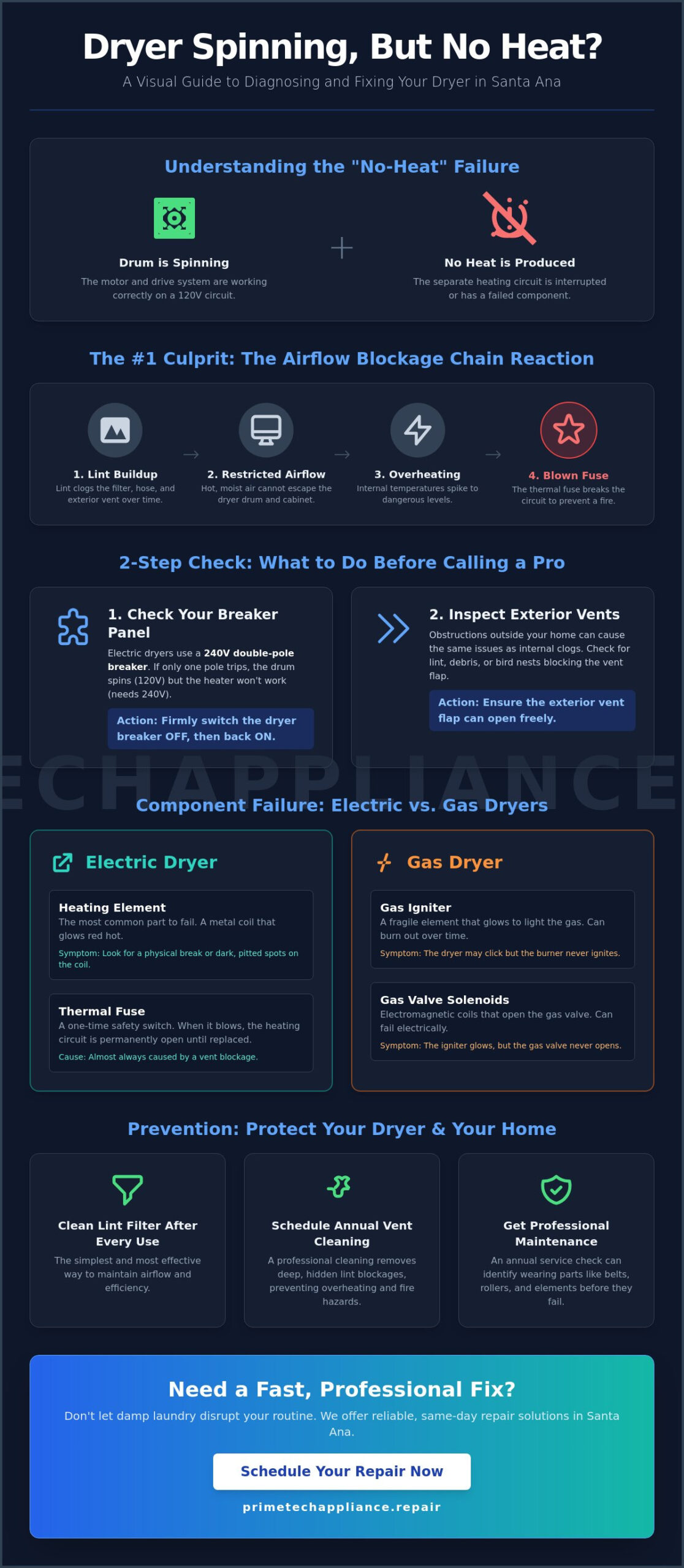
Understanding how clothes dryers work is essential for diagnosing this issue. In most units, the heating element or gas burner operates on a dedicated circuit protected by safety sensors. The most frequent culprit behind a sudden loss of heat is restricted airflow. When lint builds up in the exhaust, heat cannot escape the cabinet. This forces the internal temperature to spike, which triggers a thermal fuse to blow. This safety mechanism cuts power to the heater to prevent a house fire. You must differentiate between “no heat at all,” which usually indicates a failed fuse or coil, and “insufficient heat,” which typically points to a clogged vent or a failing thermostat.
The Impact of Santa Ana’s Climate on Dryer Efficiency
In Orange County, many residents keep laundry units in uninsulated garages. During a Santa Ana heatwave, ambient temperatures in these spaces can exceed 100 degrees. This external heat puts immense strain on your machine. High humidity levels also prevent moisture from leaving the drum effectively, forcing the dryer to run longer, harder cycles. Over time, these extreme heat cycles cause metal fatigue in heating coils, leading to a complete circuit break that stops all heat production.
Housing Styles and Venting Challenges from Floral Park to Bristol Street
Santa Ana’s diverse architecture presents unique venting challenges. In historic neighborhoods like Floral Park or French Park, many residences still utilize original 1920s-era venting infrastructure. These ducts are often made of restricted materials or feature long, winding runs that trap lint deep within the walls. This creates a permanent bottleneck that leads to rapid component burnout. Conversely, modern apartments along Bristol Street often feature compact laundry closets with restricted intake air. Without enough fresh air to circulate, the burner or element overheats almost immediately. Both scenarios require a professional eye to ensure the repair addresses the root cause rather than just the symptom.
Electric vs. Gas Dryers: Identifying the Component Failure
The first step in solving a dryer not getting hot santa ana residents often overlook is identifying the fuel source. While both machines spin the drum using a standard 120-volt motor, they generate heat through entirely different methods. Electric dryers rely on heavy-duty metal coils that glow red hot, while gas models use a burner assembly with an igniter and gas valves. Identifying which system you have is the key to pinpointing the failed component.
Power delivery is a common point of failure for electric units. These appliances require a 240-volt connection, which is supplied by two separate 120-volt legs from your home’s breaker panel. If one side of the double-pole breaker trips, the dryer has enough power to spin the drum but lacks the voltage needed to energize the heating coils. Before assuming a part is broken, always reset both poles of the dryer breaker. This simple check often resolves the issue without a service call. It is a logical first step that saves time and avoids unnecessary stress.
Regardless of the fuel type, every modern dryer features a thermal fuse. This is a non-resettable safety kill switch designed to prevent fires. If the internal temperature exceeds a safe threshold, the fuse blows and permanently breaks the heating circuit. Once this happens, the heat will not return until the fuse is replaced and the underlying airflow issue is corrected. You must never bypass this fuse for testing, as it leaves your home vulnerable to extreme heat buildup.
Electric Dryer Heating Element and Thermal Fuse Issues
In electric models, the heating element is the most frequent casualty of age and poor airflow. You can often see the damage yourself. Look for pitting, dark spots, or a physical break in the coil. If the coil is separated, the circuit is open and heat is impossible. Many ENERGY STAR certified dryers also utilize sophisticated sensor drying technology and high-limit thermostats. These thermostats act as secondary guards, cutting power if the vent is clogged. If you suspect a component burnout, seeking professional dryer repair ensures the electrical system is tested safely with a multimeter.
Gas Dryer Igniters and Solenoid Valve Failures
Gas dryers follow a strict ignition sequence: the igniter glows white-hot, the solenoid valves open, and the gas ignites into a steady flame. If you don’t see a glow through the small inspection port, the igniter has likely burned out. Another common issue involves the gas valve solenoids. These coils can weaken over time. They might work for the first ten minutes of a cycle but fail once they get hot, causing the flame to die out prematurely. This leaves your clothes damp despite the machine appearing to run normally. Reliable diagnosis requires checking these components while the machine is under load.
Troubleshooting Guide: What to Check Before Calling a Technician
Before you schedule a professional for a dryer not getting hot santa ana residents can perform a few logical checks to rule out simple fixes. Start with the power source. For electric models, ensure the plug is fully seated and the double-pole breaker hasn’t partially tripped. Even if the drum is spinning, the heating side of the circuit might be off. Flip the breaker to “Off” and then back to “On” to be certain. For gas models, verify that the gas supply valve is in the open position. Often, a simple “Touch Test” provides the best clue. Run the machine for five minutes and feel the inside of the drum. If it’s cold, the circuit is broken. If it’s lukewarm, you’re likely fighting a blockage.
Electronics can sometimes freeze or glitch due to power surges. Unplug your dryer from the wall for at least 10 minutes. This allows the capacitors on the control board to discharge fully and reset the software. While you wait, inspect the lint trap and the exterior vent cap. A stuck vent flap or a clogged screen can trap enough heat to trigger safety sensors. If these basic steps don’t restore heat, it’s time to look deeper into the internal components.
The “Hidden” Culprit: Airflow and Lint Blockages
Go outside while the dryer is running. The exterior vent flap should be open and blowing a strong, warm stream of air. If the flap is barely moving, your duct is clogged. Use a vacuum with a long hose attachment to clear the internal lint chute located behind the filter. This area often collects heavy debris that the trap misses. Always replace plastic “accordion” style venting with rigid metal ducting. Plastic vents are extreme fire hazards because they trap lint in their ridges and melt easily. Following official dryer fire safety tips is the best way to protect your property and ensure appliance longevity.
Testing for Continuity: When to Use a Multimeter
Continuity is a technical term for a continuous, unbroken path for electricity to flow. If a fuse or heating element is burned out, that path is severed. To verify this, set your multimeter to the Ohms or Continuity setting. Touch the probes to the two terminals of the component you are testing. A “good” part will show a low resistance reading or produce an audible beep. If the meter displays “O.L” or “1,” the part has failed and cannot be repaired. This test is the only definitive way to identify a faulty thermal fuse or cycling thermostat. If you find a broken circuit, contact a specialist for Dryer Repair to ensure the replacement part is installed correctly and safely.
Preventing Future Failures: Maintenance for Orange County Homeowners
Proactive care prevents the frustration of a dryer not getting hot santa ana families often face during busy weekends. While reactive repairs solve immediate crises, a consistent maintenance schedule protects your investment and ensures your machine operates safely. One of the most effective ways to avoid component failure is to stop over-loading the drum. When you cram too many heavy items into a single load, you restrict the vital airflow needed to carry moisture away. This forces the heating element or gas burner to run at maximum capacity for extended periods, leading to rapid metal fatigue. Ignoring these simple maintenance steps is the fastest way to end up with a dryer not getting hot santa ana homeowners can easily avoid through better habits.
Preventative maintenance also involves inspecting the internal mechanical parts before they suffer a total breakdown. Following the 2025 California Energy Code updates, maintaining appliance efficiency has become a priority for Orange County property owners. Belts, rollers, and idler pulleys wear down over months of use. If these parts struggle to turn the drum, the motor draws more current, which can eventually lead to electrical failures in the heating circuit. A professional technician can spot these signs of wear during a routine checkup. This expert intervention ensures that a minor part replacement prevents a much more expensive emergency repair later in the year.
Professional Vent Cleaning vs. Standard Lint Trap Care
Your lint trap is a necessary filter, but it cannot capture every particle of debris. Fine lint often bypasses the screen and settles deep within the internal ductwork. In many multi-story Santa Ana homes, these vents run through complex vertical paths that standard household vacuums cannot reach. Professionals use specialized rotary brushes and high-powered extraction to clear the entire run from the wall to the exterior cap. This thorough cleaning does more than just prevent fires. It significantly reduces dry times and lowers your monthly utility costs by allowing the machine to breathe freely.
Managing High-End Dryer Brands
Luxury European brands like Miele or Bosch require a specialized level of technical expertise. These machines feature sophisticated moisture sensors that communicate with the control board to optimize energy use. If these sensors become obscured by residue from dryer sheets or fine lint, the system may cut the heat too early. Maintaining these high-performance units requires manufacturer-approved parts and specific diagnostic tools to protect your warranty. Using generic components can lead to recurring sensor errors and poor drying results. For reliable diagnostics and precision care, you should contact PrimeTech Appliance Repair to ensure your high-end appliance receives the expert attention it deserves.
Professional Dryer Repair Services in Santa Ana
When facing a dryer not getting hot santa ana residents need a repair partner who understands the urgency of a domestic emergency. PrimeTech Appliance Repair stands as the local authority for all major brands, from standard domestic units to high-end European technology. We recognize that wet laundry piling up creates immediate stress for your household. That’s why we prioritize same-day service availability to resolve your laundry crisis before it disrupts your entire week. Our goal is simple: restore your appliance to peak performance with a single, expert intervention that provides lasting results.
Our technical approach goes beyond surface-level fixes. While a blown fuse is often the immediate culprit, we investigate the entire system to identify the root cause, such as the airflow restrictions or electrical surges discussed in previous sections. By addressing the underlying failure, we prevent recurring issues and extend the lifespan of your machine. We bring a calm, expert presence to every service call. This ensures that even complex mechanical failures have a straightforward, manageable solution that gives you back your peace of mind and a functional home.
Same-Day Diagnostics and Transparent Pricing
We believe in honest, no-nonsense advice from the moment we arrive at your home. Our technicians perform a comprehensive on-site diagnostic to provide a clear, written repair estimate before any work begins. You won’t have to worry about hidden fees or surprise costs. Because we arrive with fully stocked trucks, we complete the vast majority of repairs in one visit using the precision tools required for modern circuitry. Our commitment to Orange County punctuality and reliability means we value your property and your schedule. We work quickly to ensure your dryer is back in service without unnecessary delays or repeat visits.
Our 100% Satisfaction Guarantee and Parts Warranty
Every repair we perform comes with the peace of mind provided by our comprehensive parts and labor warranty. We never compromise on quality, which is why we use only manufacturer-approved components for every fix. This commitment ensures your appliance maintains its original performance standards and protects any existing manufacturer warranties. We take pride in getting the job done right the first time, every time. Our reputation is built on integrity and a commitment to excellence in every Santa Ana neighborhood. Schedule your expert dryer repair in Santa Ana today!
Restore Your Home’s Efficiency with Expert Dryer Care
Dealing with a dryer not getting hot santa ana residents often find their daily routines at a complete standstill. You’ve learned that whether it’s a blown thermal fuse, a broken heating element, or a clogged vent run, these issues require precise technical diagnosis to ensure a safe and lasting repair. Understanding the mechanics of your specific gas or electric model is the key to moving from a household crisis to a manageable solution. By prioritizing regular maintenance and professional airflow checks, you can protect your property from fire hazards and keep your utility bills low.
PrimeTech Appliance Repair is here to provide the expert intervention you need. We’ve been locally owned and operated in Orange County since 2019, bringing specialized knowledge to both standard and luxury appliance brands. Our team focuses on identifying the root cause of every failure, backed by a 100% Satisfaction Guarantee on all repairs for your total peace of mind. Our technicians arrive ready to restore your appliance’s performance in a single visit with fully stocked tools.
Don’t let damp laundry pile up another day. Book Your Same-Day Dryer Repair in Santa Ana Now and experience the reliability of a true local expert. We’re ready to help you get your household running smoothly again.
Frequently Asked Questions
Why is my dryer running but there is no heat?
A dryer that spins without heat usually has a broken heating circuit. Common causes include a blown thermal fuse, a failed heating element, or a tripped circuit breaker. In gas models, a faulty igniter or gas valve solenoid is often the culprit. These components operate independently from the drive motor, which is why the drum continues to turn even when the heat fails.
Is it worth repairing a dryer that is not getting hot?
Yes, repairing a heating issue is almost always more cost-effective than purchasing a new appliance. Most heating components like fuses or thermostats are relatively inexpensive compared to the price of a modern replacement unit. Since residential dryers are expected to last between 11 and 18 years, a professional repair can extend the life of your machine for several more years of reliable service.
How much does it cost to fix a dryer heating element in Santa Ana?
The total cost of a heating element repair depends on the specific parts required and the complexity of your dryer’s internal design. While industry data suggests typical repairs for heating issues fall within a specific range, you should always request a professional diagnostic for an accurate estimate. Getting a clear, on-site quote ensures you understand the value of the repair before any work begins on your appliance.
Can a clogged vent cause my dryer to stop heating?
A clogged vent is the most frequent cause of heat failure because it triggers safety shut-offs. When airflow is restricted, internal temperatures spike and blow the non-resettable thermal fuse. This permanently breaks the heating circuit to prevent a fire. Addressing a dryer not getting hot santa ana often requires cleaning the entire duct run to ensure the new components don’t burn out immediately from the same blockage.
How do I know if my dryer thermal fuse is blown?
You can verify a blown thermal fuse by testing it for continuity with a multimeter. A functional fuse provides a continuous path for electricity, while a blown fuse shows an open circuit. If your dryer runs but produces no heat, the thermal fuse is the most likely safety component that has failed. Once it blows, it cannot be reset and must be replaced to restore the heating function.
Does PrimeTech offer same-day dryer repair in Orange County?
PrimeTech prioritizes urgent laundry emergencies by offering same-day service availability across Santa Ana and the surrounding Orange County area. We understand that wet laundry creates a significant household disruption. Our technicians arrive in fully stocked vehicles to perform diagnostics and repairs in a single visit. This rapid response ensures your dryer is back in operation without the need for multiple appointments or long wait times.
How long does a typical dryer repair take?
Most dryer repairs are completed within one to two hours once the technician arrives. Simple component replacements, such as installing a new thermal fuse or heating element, are straightforward for an experienced professional. More complex issues involving control boards or gas valve assemblies may take slightly longer. We focus on efficiency and precision to get your laundry routine back on track as quickly as possible.
Can I still use my dryer if it is not getting hot?
You should not continue using a dryer that isn’t heating, even if the drum still spins. Running the machine without heat wastes electricity and puts unnecessary wear on the motor and drive belt. More importantly, if the heat failure was caused by a clogged vent, continuing to run the dryer increases the risk of a lint fire. It’s best to stop use until a professional can identify the root cause.