
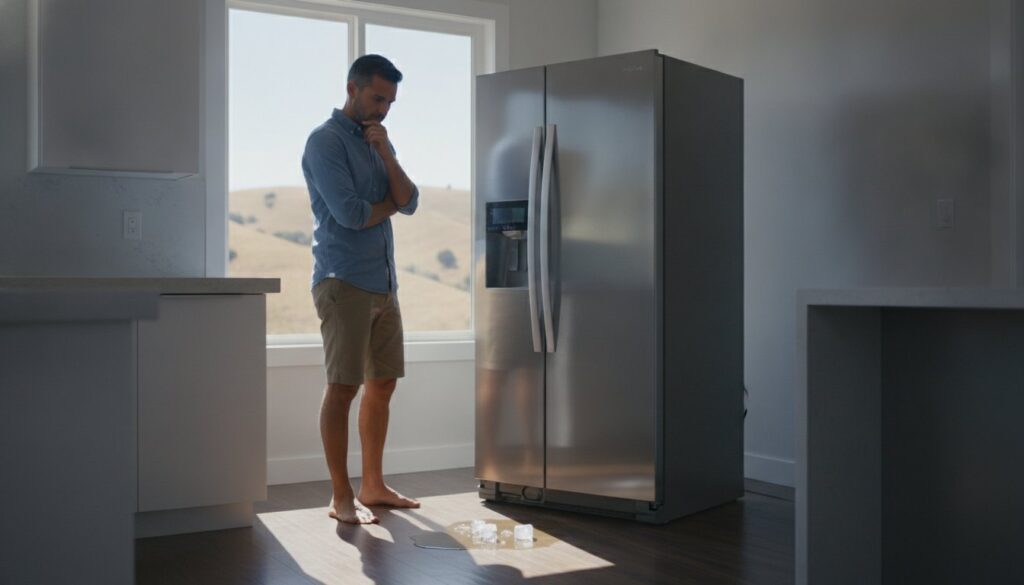
Imagine walking into your kitchen for a late-night snack only to find a puddle of lukewarm water on the floor. Your refrigerator is silent, your ice is melting, and hundreds of dollars in fresh groceries are at risk of spoiling. It’s a high-stakes moment that disrupts your household routine and triggers immediate anxiety about expensive replacements. Knowing exactly what to do when your refrigerator stops working can be the difference between a simple power reset and a total loss of your perishables. Since refrigerators are the most frequently repaired home appliance, you’re certainly not alone in this crisis.
We understand the stress of a sudden mechanical failure. You shouldn’t have to guess whether your food is safe or if it’s time to scrap a machine that has an average lifespan of 9 to 13 years. This guide provides the immediate triage steps to protect your groceries and the expert diagnostic framework needed to identify the fault. You’ll learn how to perform basic troubleshooting, when to apply the industry-standard 50% rule for repairs, and how to secure a fast, reliable solution to get your kitchen back in order.
Key Takeaways
- Act fast by keeping refrigerator doors closed and verifying power connections to buy time for your perishables.
- Inspect air vents and condenser coils for blockages that often mimic major mechanical failures.
- Decipher complex error codes for luxury brands like Sub-Zero to differentiate between minor maintenance needs and critical system failures.
- Apply the 50% Rule to determine the financial logic behind your next steps when deciding what to do when your refrigerator stops working.
- Leverage professional diagnostics to identify the exact fault and ensure a fast, reliable return to a functional kitchen.
The First 30 Minutes: Emergency Triage and Food Safety
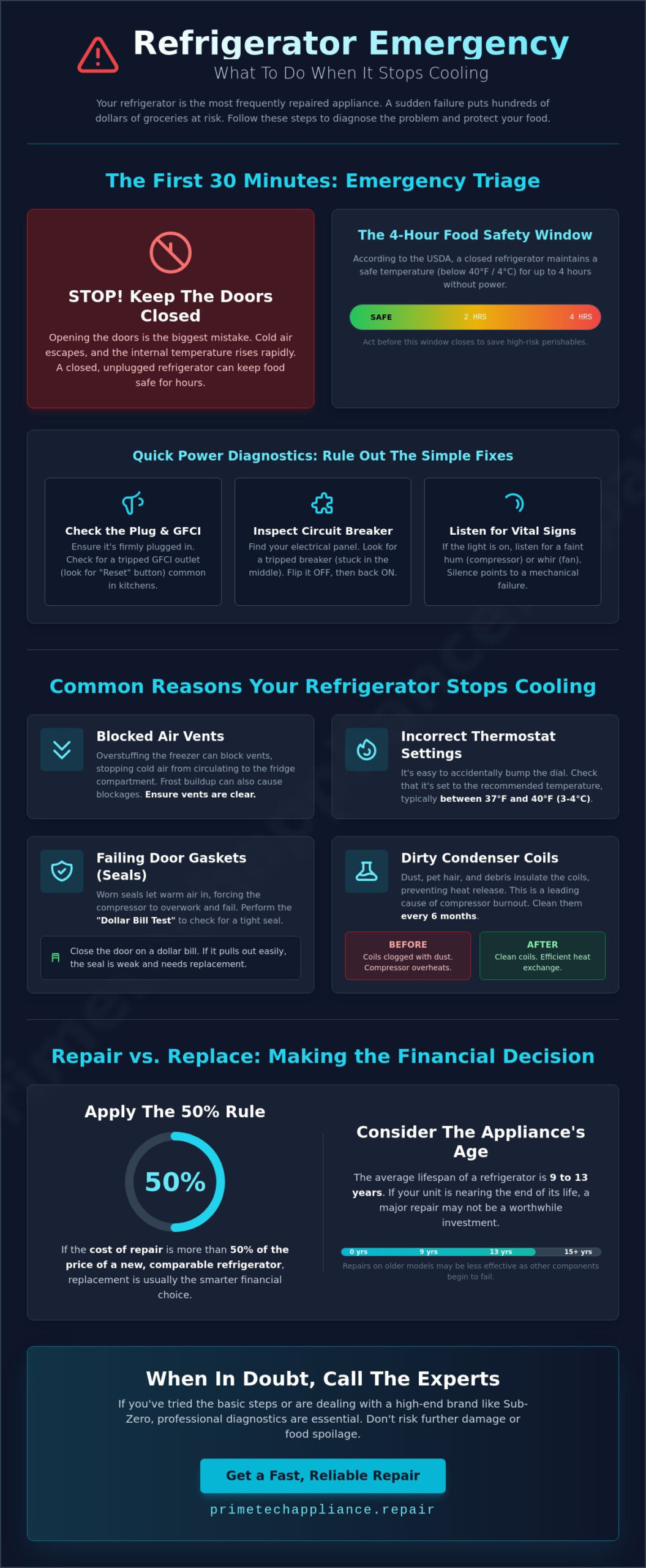
Speed is your greatest ally when a cooling failure occurs. Your first instinct might be to open the doors and check every item, but this is a mistake. Every time the door opens, cold air escapes and the internal temperature rises rapidly. Understanding how refrigerators work helps you realize that the insulated cabinet is designed to maintain a “safe zone” even without active cooling. Your primary goal in the first 30 minutes is to stabilize the environment and confirm whether the issue is a simple power glitch or a mechanical breakdown.
The urgency of the situation cannot be overstated. Knowing exactly what to do when your refrigerator stops working will save you from the high cost of replacing a week’s worth of groceries. Start by verifying the power source. It sounds basic, but a loose plug or a tripped circuit breaker is often the culprit. If the interior lights are off, you have an electrical issue. If the lights are on but the unit is silent, the problem is likely mechanical.
Quick Power Diagnostics
Perform these checks immediately to rule out external failures:
- Check the GFCI Outlet: Most modern kitchens use Ground Fault Circuit Interrupter outlets. These can trip due to a minor power surge, cutting off the fridge while the rest of the kitchen stays powered.
- Inspect the Circuit Breaker: Locate your home’s electrical panel. Look for a switch that is stuck in the middle position. Flip it fully to “Off” and then back to “On” to reset the circuit.
- Listen for Vital Signs: Place your ear near the back or bottom of the unit. You should hear a faint hum from the compressor or the whirring of a fan. Silence indicates a total loss of power or a failed start relay.
The 4-Hour Rule for Food Safety
According to USDA guidelines, a closed refrigerator will keep food safe for up to 4 hours during a power loss. This is your “Safety Window.” If you haven’t restored cooling within this timeframe, the internal temperature will likely climb above 40 degrees Fahrenheit, which is the threshold for rapid bacterial growth.
Don’t wait until the four hours are up to take action. If the unit remains dead after your power checks, identify high-risk perishables immediately. Items like raw meat, poultry, fish, soft cheeses, and leftovers should be moved to a cooler with ice or dry ice. Hard cheeses, fresh fruits, and vegetables are more resilient and can stay in the unit longer. If you’re unsure about an item’s safety after the window has passed, remember the golden rule of food safety: when in doubt, throw it out.
Common Reasons Your Refrigerator Stopped Cooling
If your power checks didn’t reveal a tripped breaker, the solution might be simpler than you think. Many households struggle with common refrigerator problems that don’t require internal electronic repairs. Before assuming the compressor has failed, check these four critical areas. Understanding what to do when your refrigerator stops working often starts with identifying basic maintenance oversights or user errors that disrupt the cooling cycle.
Airflow and Vent Management
Refrigerators rely on a specific “chimney effect” to circulate cold air from the freezer to the fresh food compartment. If you’ve recently overstuffed your freezer with bulk groceries, you might be blocking the evaporator fan or the return air ducts. Locate the vents at the back of the freezer. If they’re blocked by a large box or a bag of ice, your fridge will stop cooling almost immediately. A frost-clogged duct is another common sign of airflow failure. This usually happens when a door is left ajar, allowing humid air to freeze over the internal pathways.
Don’t overlook human error. It’s easy to bump the thermostat dial while moving items on the top shelf. Ensure the settings are at the manufacturer’s recommended levels, usually between 37 and 40 degrees Fahrenheit. Next, inspect the door gaskets. These rubber seals keep cold air in and heat out. Perform the “dollar bill test” by closing the door on a dollar bill. If it pulls out easily without resistance, your seal is failing. This allows moisture and heat to enter, forcing the unit to work overtime until it eventually quits.
Condenser Coil Maintenance
In Orange County, our environment plays a significant role in appliance longevity. Dust, coastal salt air, and pet hair act as “fridge killers” that accumulate on condenser coils located at the bottom or back of your unit. Heat transfer fails when coils are insulated by dust, causing the compressor to run constantly and eventually burn out. If you haven’t cleaned your coils in the last six months, this is likely the root of your cooling issues.
To clean them safely, follow these steps:
- Unplug the unit: Always disconnect power before performing maintenance.
- Access the coils: Remove the base grille at the front or pull the unit away from the wall to reach the rear panel.
- Vacuum the debris: Use a narrow wand attachment or a specialized coil brush to remove thick layers of dust.
- Clear the area: Ensure there is at least an inch of space around the unit for proper ventilation.
Regular upkeep is vital for preventing expensive mechanical failures. If the coils are heavily impacted or difficult to reach, scheduling Preventative Maintenance Services ensures your high-end unit remains efficient and reliable. If these steps don’t restore cooling, it’s time to look at more complex diagnostic codes.
Advanced Troubleshooting for High-End Luxury Brands
Owners of luxury appliances like Sub-Zero, Viking, or Wolf face a unique set of challenges. These machines are engineered for superior performance and longevity, often lasting over 20 years with proper care. However, their sophisticated electronic monitoring systems can be intimidating during a crisis. When these units fail, they often provide specific diagnostic feedback through digital displays or indicator lights. Knowing what to do when your refrigerator stops working in a luxury kitchen requires a technical understanding of these built-in alerts.
High-end units prioritize system protection above all else. For example, a flashing “Vacuum Condenser” light on a Sub-Zero is more than a maintenance reminder. It indicates that the compressor is working too hard due to restricted airflow. If ignored, the onboard computer may shut down the cooling cycle entirely to prevent a catastrophic compressor failure. While you manage these technical alerts, keep food safety during a power outage or mechanical failure in mind. Even a premium refrigerator cannot protect perishables once the internal temperature exceeds 40 degrees Fahrenheit for more than two hours.
Interpreting Digital Error Codes
Luxury brands use specific codes to communicate internal faults. On a Sub-Zero, code EC 40 suggests excessive compressor run times, while EC 50 indicates a fault with the evaporator thermistor. Viking units may display “Service” or “High Temp” alerts. Distinguishing between a user-clearable alert, like a dirty condenser, and a mechanical failure is vital. Never attempt to bypass or repair digital circuit boards yourself. These components are highly sensitive to static electricity and require precise, manufacturer-approved parts to maintain the unit’s warranty and performance standards.
Dual Compressor Failures
One of the primary benefits of brands like Wolf and Sub-Zero is the dual compressor system. This design uses separate cooling loops for the refrigerator and freezer compartments. If your freezer is perfectly frozen but your fresh food compartment is warm, you are likely dealing with a failure in only one half of the system. This could be a failed inverter board, which controls the variable-speed compressor, or a leak in the sealed system.
Identifying the exact fault requires specialized electronic testing tools and technical training specific to these high-performance machines. Because these units are built to be serviced rather than replaced, a professional diagnostic is almost always the most cost-effective path forward. Relying on expert intervention ensures that the integrity of the dual-cooling logic is preserved, protecting your investment for another decade of service.
Repair vs. Replace: Making the Financial Decision
Deciding what to do when your refrigerator stops working often comes down to a simple calculation. You must weigh the immediate cost of a professional service call against the long-term investment of a brand-new appliance. While the average lifespan of a refrigerator is between 9 and 13 years, the decision isn’t always based on age alone. Industry experts suggest using the “50% Rule” as your primary decision-making tool. If a repair estimate exceeds half the price of a comparable new unit, replacement is usually the smarter financial move.
For budget or mid-tier units, a failed compressor or a leak in the sealed system is often the “death knell.” These repairs are labor-intensive and require specialized equipment to handle modern refrigerants. When you factor in the cost of parts and labor for a 10-year-old standard unit, you’re often better off purchasing a modern model. However, the logic changes entirely for luxury brands. High-end appliances like Sub-Zero, Viking, or Miele are designed with a different philosophy. Because their replacement costs range from $5,000 to over $15,000, a repair is almost always the more logical choice. These units are built to be serviced and have a much longer expected lifespan.
Calculating the Real Cost of Repair
Don’t look at the sticker price of a new unit alone. Consider parts availability; if a manufacturer no longer produces control boards for your 12-year-old model, a repair might be impossible. Also, factor in energy efficiency. Newer models comply with stricter DOE standards, potentially saving you money on monthly utility bills compared to an older, struggling unit. At PrimeTech, we provide transparent pricing and a 100% satisfaction guarantee to help you make this choice with confidence. Schedule a professional diagnostic to get an accurate estimate before you commit to a major purchase.
Environmental Impact of Appliance Disposal
Choosing to repair your appliance is also the sustainable choice for the community. It keeps bulky machines out of Orange County landfills and reduces the carbon footprint associated with manufacturing and delivering a new unit. Professional repair can extend a high-end refrigerator’s life to 20 years or more. By maintaining your current unit, you maximize your initial investment while minimizing your environmental impact. Regular maintenance ensures that your appliance runs at peak efficiency, which further reduces waste and energy consumption over time.
Professional Refrigerator Repair in Orange County
A refrigerator emergency doesn’t wait for a convenient time. When you’re deciding what to do when your refrigerator stops working, the speed of the response is as important as the quality of the fix. Every hour the unit remains non-functional increases the risk of food spoilage and potential property damage from leaks. We prioritize rapid intervention to protect your kitchen and your investment. Our team understands that a broken fridge isn’t just a minor inconvenience; it’s a disruption to your family’s health and daily routine.
Our technicians don’t rely on guesswork. The PrimeTech diagnostic process is a systematic evaluation of your appliance’s health. We begin with a thorough visual inspection of external components like gaskets and coils. We then move to precision electronic testing of the control boards, sensors, and compressors. This ensures we identify the root cause of the failure rather than just treating the symptoms. We proudly serve the entire region, including Irvine and Newport Beach, providing the local expertise needed for fast, reliable results.
Why Choose PrimeTech Appliance Repair?
Whether you own a standard household unit or a high-performance Sub-Zero, our team has the specialized training required for complex repairs. We use only manufacturer-approved parts to ensure your appliance operates at its original factory standards. To provide you with total peace of mind, we offer a 100% satisfaction guarantee on all our labor. Our skilled technicians are equipped with the latest tools to provide same-day solutions for most mechanical issues. We value your time and property, arriving on schedule and leaving your kitchen as clean as we found it.
Book Your Diagnostic Appointment Today
Restoring your kitchen shouldn’t be a stressful process. We focus on transparent pricing and clear communication so you’re never surprised by the final bill. Scheduling a professional assessment is straightforward and fast. Don’t let a minor mechanical fault turn into a total appliance replacement. Take the first step toward a functional home by choosing a partner who values integrity and technical excellence. Our commitment to quality ensures that your repair is done right the first time, every time.
Schedule your Orange County Refrigerator Repair today to secure your groceries and restore your peace of mind.
Restore Your Kitchen’s Vitality Today
A refrigerator failure is a race against time, but you now have the tools to manage the crisis effectively. By prioritizing immediate food triage and performing basic power diagnostics, you’ve already taken the most important steps toward saving your groceries. Whether you are clearing dust from condenser coils or deciphering complex error codes on a luxury unit, your proactive approach minimizes stress and prevents unnecessary replacement costs. Each step you’ve learned helps bridge the gap between a cooling emergency and a fully functional kitchen.
Knowing exactly what to do when your refrigerator stops working ensures that a mechanical fault remains a manageable hurdle rather than a household disaster. If your troubleshooting steps haven’t restored cooling, it’s time to bring in professional expertise. We specialize in precision diagnostics for both standard models and luxury brands like Sub-Zero and Viking. With our 100% satisfaction guarantee and commitment to factory-standard labor, you can rest assured that your appliance is in capable hands.
Save Your Groceries: Book Same-Day Refrigerator Repair in Orange County today. Our team is ready to provide the fast, reliable solutions you need to get your daily routine back on track. You don’t have to face a warm fridge alone; expert help is just a click away.
Frequently Asked Questions
Is it worth repairing a 10-year-old refrigerator?
Whether a 10-year-old unit is worth repairing depends on its brand and the specific component that failed. For standard budget models, a major repair at this age often exceeds 50% of the cost of a new unit, making replacement the more logical choice. However, luxury brands like Sub-Zero or Viking are designed to last 20 years or more, so a professional repair is almost always a sound investment for these high-end machines.
How long can food stay in a broken refrigerator before spoiling?
Perishable food remains safe for up to 4 hours in a closed, non-functional refrigerator. After this window, the internal temperature typically rises above the 40-degree safety threshold, allowing bacteria to grow rapidly. If you can’t restore cooling within this time, move high-risk items like meat, dairy, and eggs to a cooler with ice to prevent spoilage and potential foodborne illness.
Why is my fridge making a clicking sound but not cooling?
A clicking sound followed by silence usually indicates a failed start relay or a compressor that’s struggling to turn over. The click you hear is the thermal overload protector cutting power to the motor to prevent it from overheating. This is a technical issue that requires a professional diagnostic to determine if the relay just needs replacement or if the compressor itself has suffered a terminal failure.
Can I lay a refrigerator on its side to check the bottom?
Never lay a refrigerator on its side. Doing so allows the oil in the compressor to flow into the cooling lines, which can cause a permanent blockage once the unit is turned back on. If you must tilt the unit for an inspection, never exceed a 45-degree angle. Always keep the refrigerator upright during transport or maintenance to protect the integrity of the sealed system and its mechanical components.
What is the average cost of a refrigerator compressor repair?
Compressor replacement is a major technical undertaking that involves opening the sealed system, recovering refrigerant, and soldering new components. Because it requires specialized tools and certified labor, it’s often the most expensive repair a refrigerator can undergo. For many standard units, the cost of a new compressor often makes replacement a more attractive option than repair, though luxury units should always be serviced.
Why is my freezer cold but my refrigerator is warm?
A freezer that stays cold while the refrigerator warms up typically signals a failed evaporator fan or a blocked air vent. Since the freezer is the primary source of cold air, a fan must push that air into the refrigerator compartment. If the fan fails or if the return air ducts are clogged with ice or overstuffed groceries, the refrigerator will lose its cooling capacity while the freezer remains functional.
How do I reset the control board on my refrigerator?
You can often reset a refrigerator control board by performing a hard power cycle. Unplug the unit from the wall for at least 10 minutes to allow the electrical capacitors to discharge fully. This simple step can clear minor software glitches and is a vital first step when deciding what to do when your refrigerator stops working. If the display remains unresponsive after plugging it back in, you likely have a hardware failure.
Does PrimeTech offer same-day refrigerator repair in Irvine?
PrimeTech provides rapid response and same-day service for refrigerator emergencies throughout Irvine and the surrounding Orange County area. We understand that a cooling failure is a race against time to save your groceries and restore your household routine. Our technicians arrive with the necessary diagnostic tools and manufacturer-approved parts to resolve most mechanical issues during the very first visit, ensuring a fast and reliable solution.